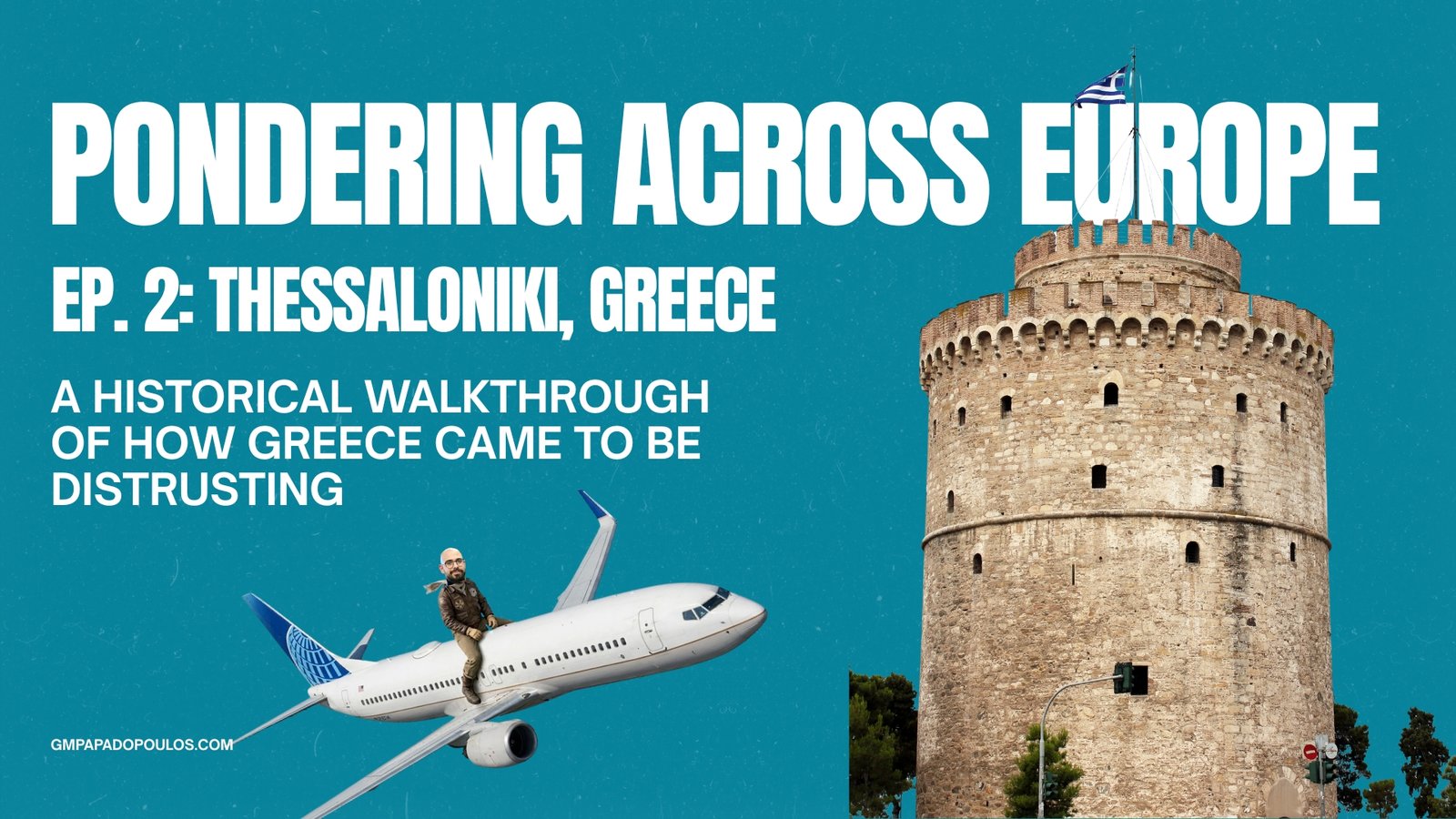
Lately, my life has been defined by constant change. Crossing European borders for my Erasmus Mundus in Impact Entrepreneurship has shifted my perspective, and this new blog series is the direct result of that journey.
It’s a bet on myself; I want to bring together two fundamentally opposed lenses. The romantic, leisurely vibe of a travel log, filled with imagery, commentary, and practical tips, and the grounded reality of socio-economic and political analysis, anchored by hard data, philosophy, and scholarly sources.
Will this unconventional marriage of vibes and variables actually work? You get to be the ultimate judge.
Catch up with the first episode of Pondering Across Europe in Athens before this one!
“Thessaloniki? Which island is this? I’ve never heard of it!”
I’ve heard this line quite a few times in my lifetime. Matter of fact, nowadays I’m even premoving it, as I’m mentally sitting on an online chessboard: “I’m from Thessaloniki and, no, no it’s not an island!” Sometimes, there is surprise in the other person’s face at the fact, considering how Greece with its endless seafront can easily pass as an archipelago. That is, if one has never had access to any European maps in their lifetime.
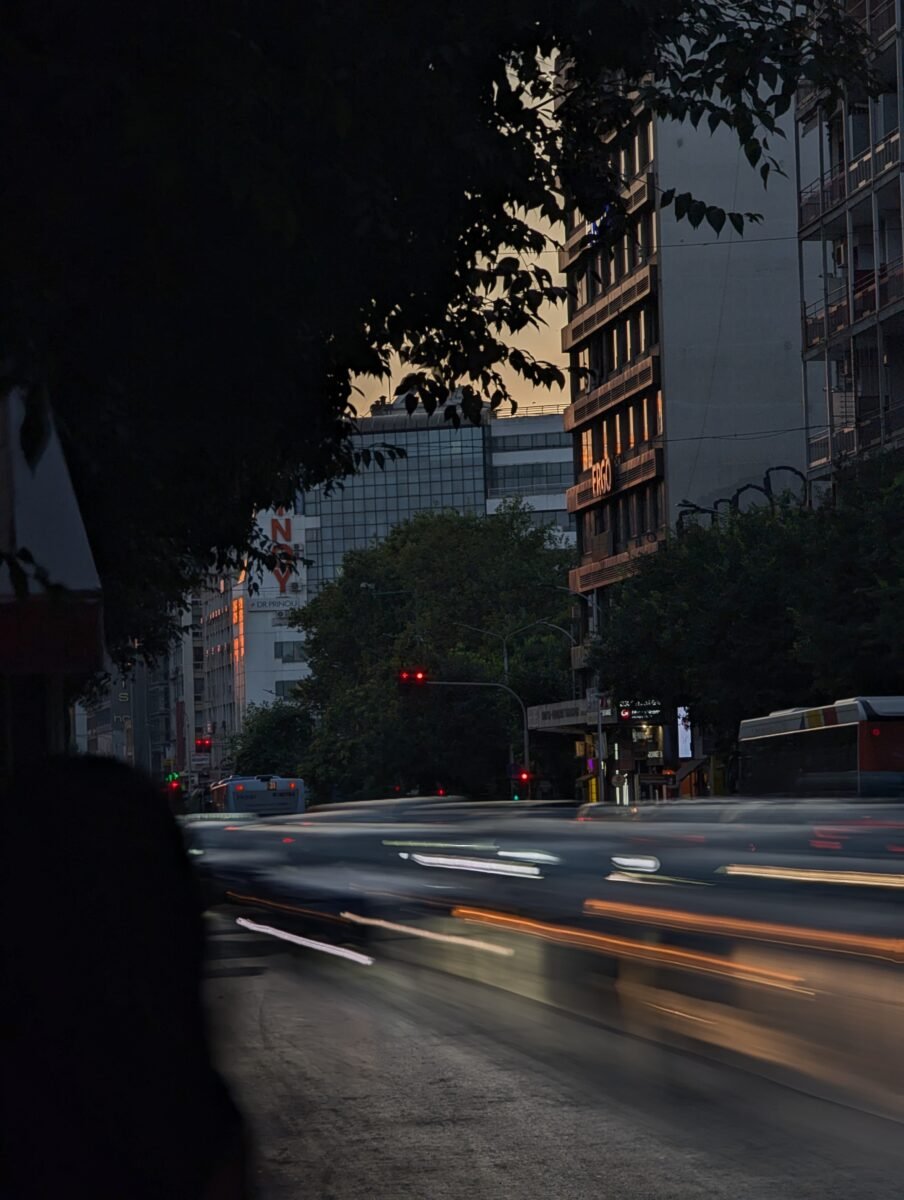
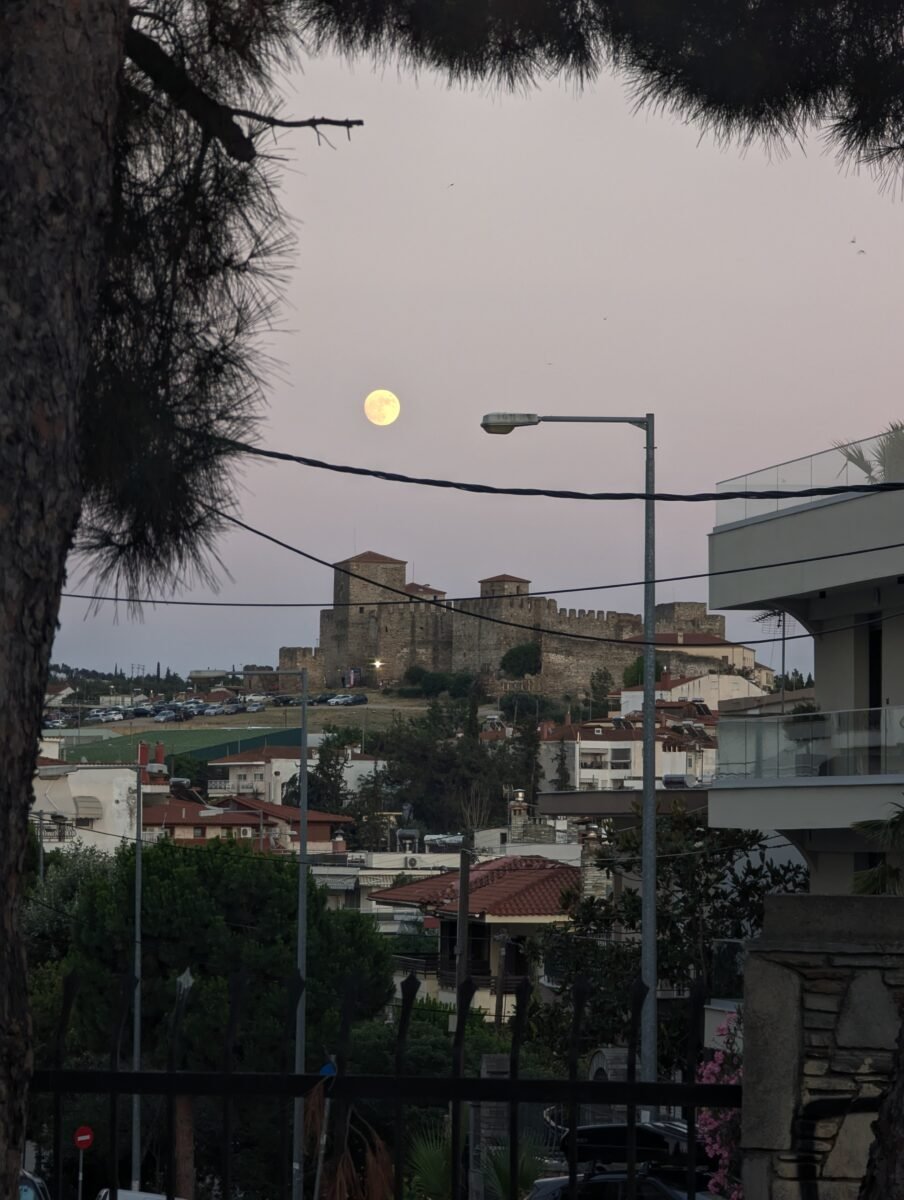
My hometown is anything but what the outsider’s view would suggest. There are no white, picturesque houses, except a white tower that’s tanned at best. From its own highest point, Eptapyrgion, one can ponder the same concrete chaos seen in Athens, as well as in most other Greek cities; yet, blended in at random, ruins from over two millennia of constant existence pop up. Byzantine churches, Ancient Roman ruins, Venetian castles, Churches-turned-mosques-turned-churches, modern art and graffiti, and statues of antiquity coexist with the endless lines of cars and people constantly populating its congested arteries.
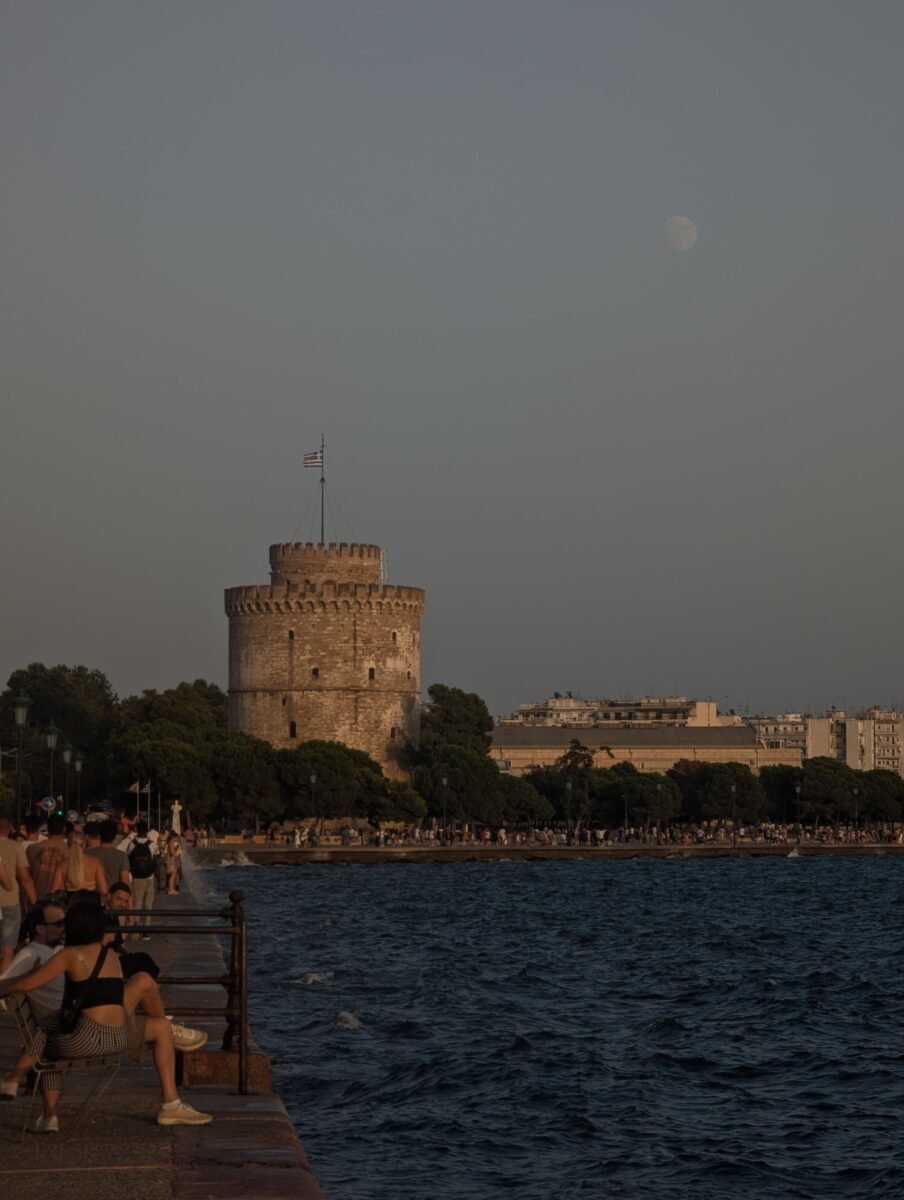
Here, to this view, I brought quite a few foreigners, wishing to show them around my origins. More or less, we follow the same route; starting from Eptapyrgion & taking the downhill towards the seafront, through the charmingly authentic Ano Poli, ending in the tour of the city centre with its Roman Agora, the Rotonda with its disused Ottoman Minaret & Roman Emperor Galerius’ Kamara, to Aristotelous square, to Agia Sofia. Usually, panting for air, desperately overheated & sweaty, we end in the city’s landmark: the White Tower, a tower built after the Ottomans won the city from its short-lasting Venetian rulers.
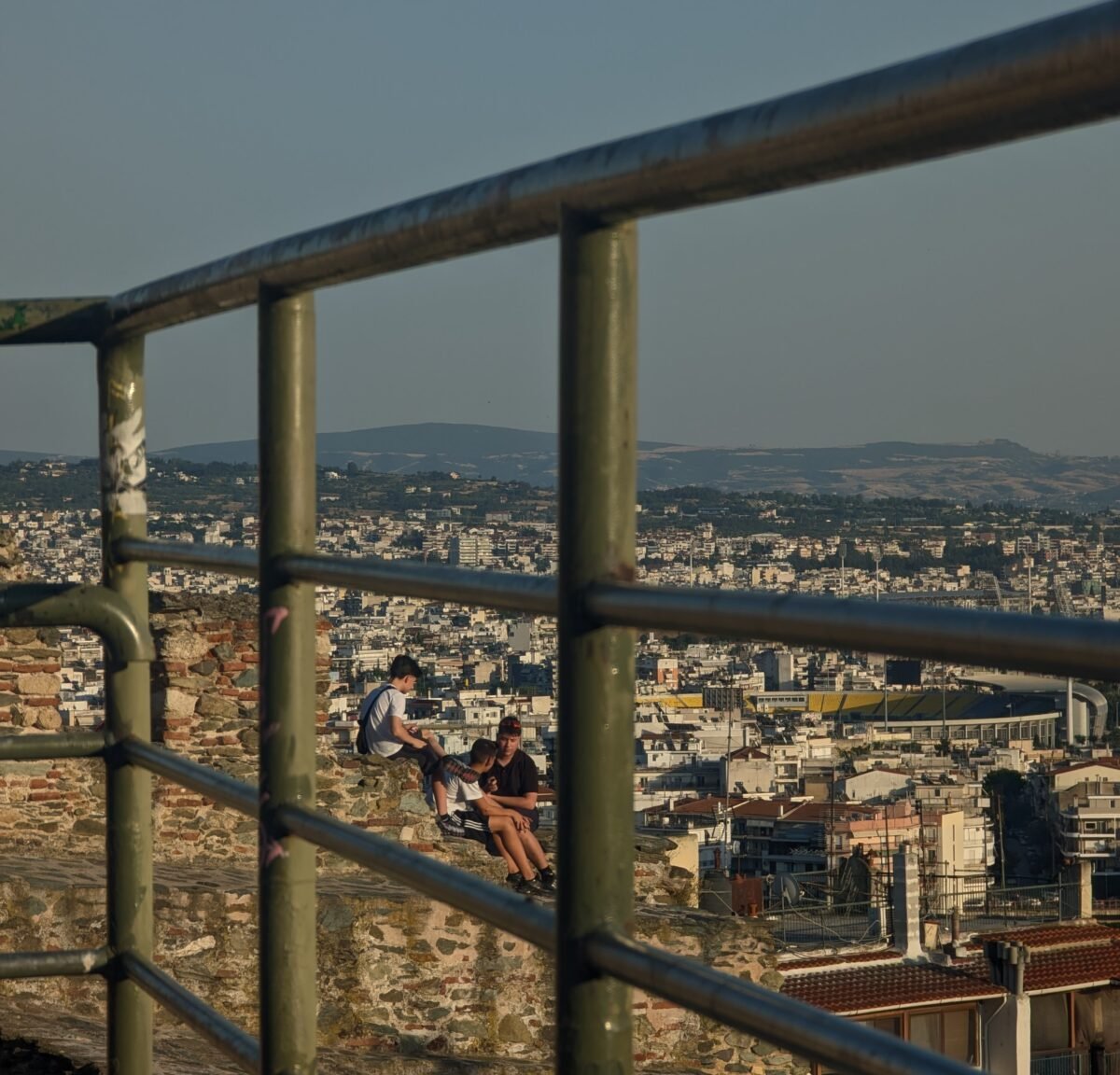
Table of Contents
And their reaction?
Watching the calm, modern seafront filled with noisy passing Greeks and tourists walking across its start and end, the old port and the city’s music hall respectively, I encourage them to ponder: “What do you think?”
But they rarely share my view of awe and aspiration. Sometimes, between the lines, I can see their disappointment.
To their eyes, what to me feels like raw, chaotic beauty is a noisy, dirty mess. The city itself also begs the question: Is Thessaloniki.. Greek? How can it be?
Yes. Yes, it is. In its somewhat deserted, laid-down state, this city is unmistakably Greek: modern Greek. And, contrary to popular belief, modern Greece, in the span of the millennia of this nation, has been shaped into a polymorph of cultures, ethnicities, a blend of all the conquerors, visitors, and locals who left their mark; not to the city, but to the nation as a whole.
How? How did it all come to be?
And why does this even matter?
Thessaloniki’s Origins
Thessaloniki, in comparison to Athens or Sparta, isn’t as ancient. Yet it was founded at the foundations of the Hellenistic Age, the peak of Ancient Greek prominence.
The Hellenistic Age began only after Greeks finally rallied under one force to conquer half of the known world at the time. Willingly so? Absolutely not! It took a certain Aristotle-taught, Greek-championing Alexander the Great, who, after inheriting the throne from his father, Philip II, and only after bloodily reconquering all Greeks (completely leveling an entire city, Thebes, just for good measure), spread the Hellenic culture by force and might, from Europe to the very edge of India. In his way, he became an Egyptian god, toppled the Hellenic states’ arch-nemesis, the Persian Empire, and changed the course of history forever. And then, he died, at the ripe age of… 32.
Such rapid expansion of one small city-kingdom, with the sudden, mysterious death of its charismatic leader, was impossible to maintain. The empire broke into numerous parts under his generals, and one of them, Antipater – the one who stayed behind as Alexander’s regent in ruling and protecting the kingdom – became Macedon’s ruler. He also died, passing over his son entirely in the game of succession (rude), naming the general Polyperchon as his heir. His son, Cassander? Well, he went to war and took Macedon anyway (also rude).
It is here where the story of Thessaloniki begins, as Cassander founded the city, naming it after his wife: Philip II’s daughter & half-sister of Alexander the Great, Thessalonike. For any romantics out there cooing over this, it is argued by historians that he forced his marriage to secure his lineage and legitimacy. What matters is that the city was too well-positioned not to play a role in the coming centuries; and played a role, it did.
An Identity & City Too Hard To Die
The Hellenistic times lasted just before we started counting years with AD, with the fall of Cleopatra at 30 BCE. Macedon and many of the empires born from Diadochi (i.e., the events unfolded after Alexander the Great’s death) lived on, fighting with one another for control. Other Greek kingdoms rose to power & scrambled as well, such as the Pyrrhus-led Epirus or Syracuse in Magna Grecia (modern-day Sicily & Southern Italy). In their internal bickering, however, they failed to become an immovable object for an unstoppable force that was about to conquer them: Rome.
The Roman Republic and subsequent Empire are multicomplex subjects of their own, and how can they not be? But as much as I would love to write more about them, I bring them up as a point here because, while they eventually subjugated the Greek city-states militarily, the Greek culture proved to be simply unbeatable.
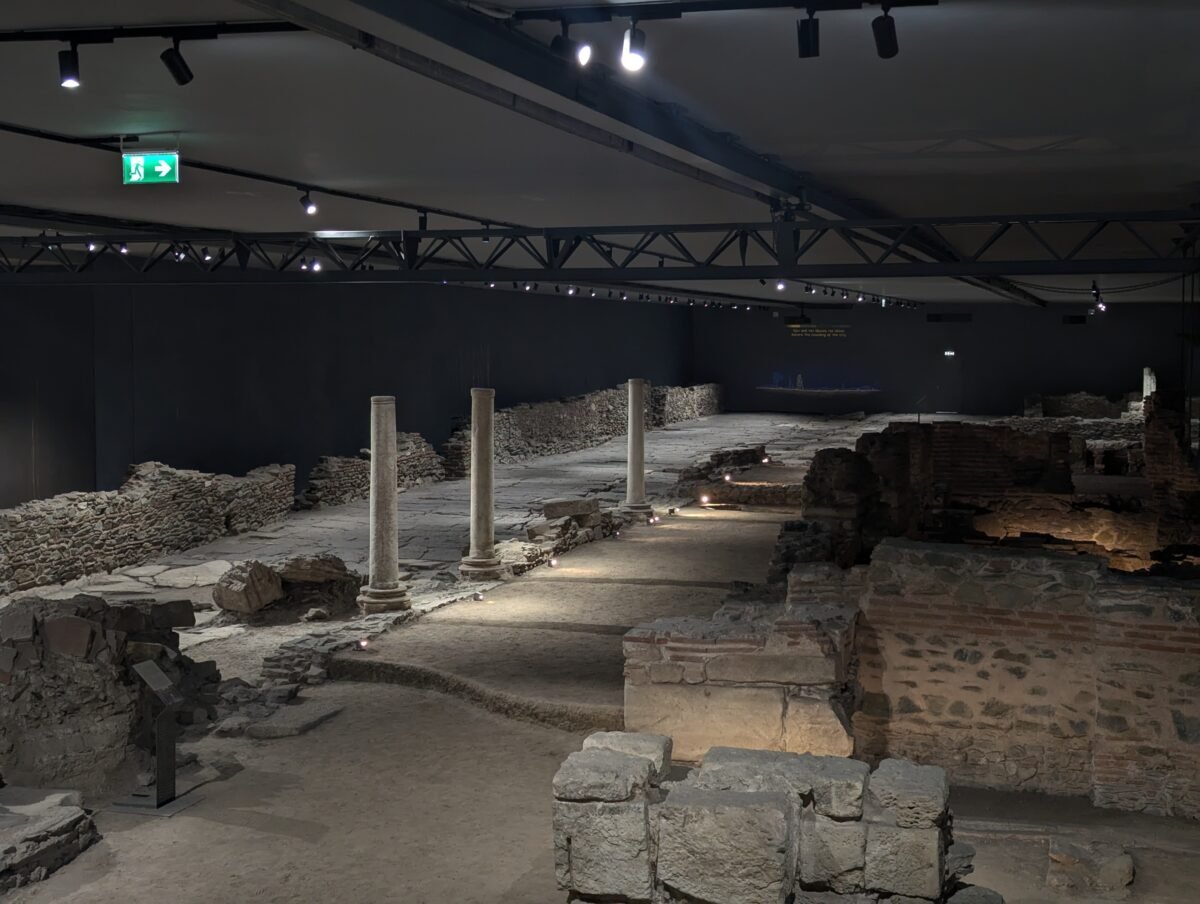
The metro has been under construction for almost two decades, partly because of the findings. The solution chosen was to remove and reassemble the findings into the main metro station, one of the most unique worldwide. Thessaloniki, Greece.
This is not a dig at the Romans, which I admire and, hopefully, would write about in detail at some point. Romans were, undoubtedly, and without any sense of guilt, copying. What were they copying? Copious amounts of anything worth copying. Be it military strategies, be it ships from Carthage, be it cavalry from Numidia, they were open to new ideas wherever they went.
And Greek culture was too good not to copy. The Roman gods were significantly influenced by the Greek ones. Roman architecture and arts drew heavy inspiration from Greece. Greek philosophies, particularly Stoicism, shaped the thought processes of some of the most renowned emperors, like Marcus Aurelius. And while later European elites who wished to portray their elite status spoke Latin, Romans who wished to do the same spoke… Greek!
Greece was under the formidable Roman formations, but under the shadows, within their iron-shielded testudos, the Greek influence was heavily prevalent. It took one Christian-converted one-quarter of an emperor, Constantine, to consolidate power against the other quarters, subsequently moving the capital from Rome to Constantinople; a location so well strategically placed that it instantly captured the heart of Constantine. From that point onwards, the Latin-speaking Roman Empire of the old went into its decline. In its place, the Greek-speaking Eastern Roman Empire, what we now call the Byzantines, lasted for 1,000 years.
Over all this time, Thessaloniki only rose in significance. What we Thessalonikians proudly call a co-capital finds its roots in the Byzantine Empire. Thessaloniki, the symbasileuousa (i.e., co-reigning in Greek), was such an important city for the empire for all of its existence.
The Latins and the treacherous Fourth Crusade in 1204 brought Constantinople down; yet it was liberated after half a century, with the Byzantines managing to hold out for an extra 200 years. Until 1453, May 29th. Until the constant bombardment, siege, and manpower overpowered the Greeks protecting the city: the last Roman emperor, Konstantinos Palaiologos, left his last breath as a defender, and the city that was raised by Constantine fell with one as well.
With that day, any notion of ancient Greece fell. The new Greek state started to shape; quietly, in shackles, under that new administration.
The Rise & Death of the Ottoman Empire
What I might say, as a Greek, might read as extremely unpopular. Yet it has to be said, with the same benefit of the doubt procedure I gave above: for an empire to last for five centuries, five centuries that began with the Gutenberg press and ended with steam, electricity, and aviation, is a testament of strength and resilience. To survive, as an administration that subjugates various ethnic, religious, or linguistic groups under one turban, in this vast span of centuries, is a marvelous historical achievement.
It took years of constant decay to finally fall, and extreme determination (and luck) to rise from its ashes so strong. In its process of dissolution, the Ottoman CUP undertook the largely recognized Armenian genocide in 1915, and started the Greek Pontic genocide that sadly remains significantly unrecognized. After siding with the Central Powers in WWI, what was known as the sick man of Europe for over a century disintegrated; the sultan became a figurehead, its enemies and foreign powers were on all its fronts, and, worst of all, one was eager to put lots of boots on the ground to liberate what it thought was theirs. That country, for the first time in its modern history acting as the major offender, was Greece.
Greek forces under its arguably best leader of the 20th century, Prime Minister Eleftherios Venizelos, landed in Smyrna (modern-day Izmir) in 1919, allowed by the Entente as a prize for participating in WWI. At the time, the city itself was indeed half Greek, with other major Greek minorities in the external region. Nevertheless, for those Turks that remain, the occupation, even under Venizelos’ moderate & diplomatic stance, was evidently somewhat oppressive. The powers knew; but they reluctantly agreed in letting Greece administer the region for five years, while officially never passing the ownership away from the Sultan. After that grace period, locals would vote on their proposed fate: Return to the Ottomans, or reunite with Greece?
If history had its way, this may have ended with a more peaceful resolution for both nations. Greece wouldn’t have the military might to hold the region, nor would other powers be willing to help. A reorganized Turkey, under any competent leadership, would be able to strangle the area, weakening it over time. Maybe the countries could have made amends without the bloodshed. No one knows how history would play out in other scenarios; but in ours, that was not how history unfolded.
The Greco-Turkish War & The Origins of Turkey
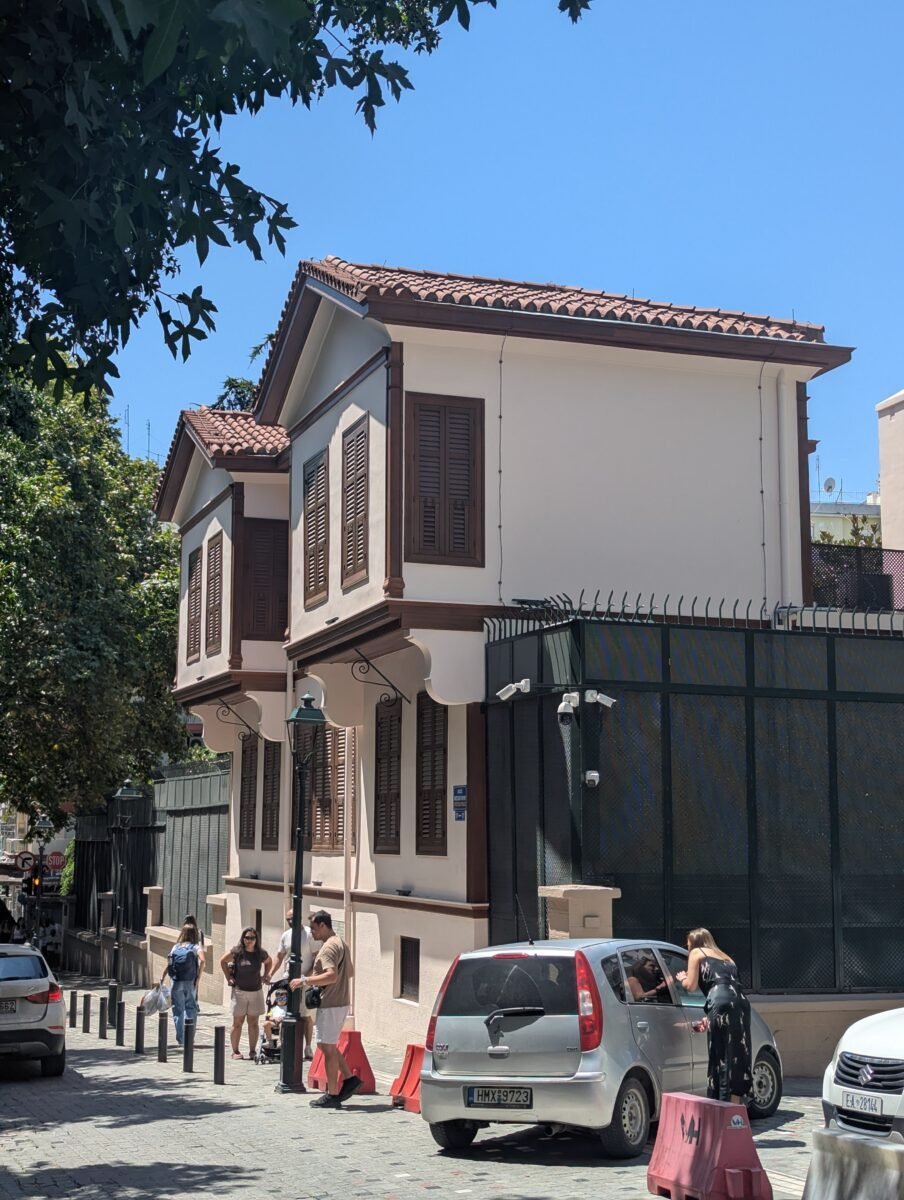
Oversimplifying, tensions in Greece grew horribly, and Venizelos called for elections, which he actually lost. The king of Greece, Alexander, died from a monkey bite (I can’t make that shit up), which brought exiled Germanophile King Konstantine back to the throne, giving the perfect excuse for the powers to cut ties with Greece even more. To make matters worse: on the other side, there was a person who could lead Turkey competently. In fact, he became one of the best leaders of the 20th century worldwide. Fate had it that he was born in, yes, Thessaloniki; and that man is Kemal Ataturk.
Greeks, unable to admit defeat and to save face, gambled it all in an extreme offensive; the goal was to decapitate the leadership of Kemal before it got established. The army went for the kill, even reaching 50 km away from Ankara, but fierce Turkish resistance, revamped with the charismatic leadership of Kemal, the support of the Bolsheviks, and the parallel lack of support for the Greek cause – which, again, in this case, became the aggressor -, proved that the advance was both short-lived & reckless in its supply lines. With reinforcements, Greek forces were nearly encircled, retreated without a plan, and, most cowardly, not only burned & pillaged on their way back, but failed to save the Greek citizens of Ismir, assuring them that all was well. Why? Because they would, due to the miserable upcoming loss, bring a revolution.
The Turks arrived in Smyrna in September of 1922. When they did, a fire broke out, starting from the Armenian quarters, spreading to the Greek & European ones, incinerating half the city – the fact that Turkish & Jewish quarters were somehow spared does show that, this time, it was not the fault of the (already retreated) Greek army. Terrified, Greeks pleaded with the anchored Allied ships for a passage back to Greece, but except for very few – like the Japanese Tokei-maru, which may or may not have happened, but we still Arigato the Japanese for it – refused to help. Many jumped into the water, hoping they would be pitied and picked up by the ships, but drowned in the process. Most of those Greeks who stayed met a brutal end. My great-grandma was one of those who managed to board the ships, but her dad was killed in the process. She came to live in Thessaloniki.
Greeks were forced to the negotiating table, and the Treaty of Lausanne was signed. Along with it, it sealed the fate of populations from both sides: Greeks in Asia Minor, Muslims in modern-day Greece.
That marked the end. The end of three millennia of Greek inhabitants in Asia Minor, but also the end of the Ottoman Empire; that from a multi-ethnic empire, attempted to set a path on a secular, Turk-based identity.
The beginning and the end of the Ottoman Empire, and, subsequently, the lives of Greeks under a Muslim foreign rule, except for those who stayed in now-named Istanbul for a couple of decades more; yet, what happened to those five centuries in between?
Why, just why, does all this matter to our initial story about lack of trust in Greek societies?
The Oppressive Institutions of the Ottoman Empire
In his book “Pedagogy of the Oppressed”, Paulo Freire stresses how humans battle between two sides of the same coin: the oppressors and the oppressed. People go through various stages in their lifetimes, enacting these two identities in all their various social contexts. Changing places, even, when events bring them to gain or lose power.
Greece, as well as other Balkan nations, was subjugated for centuries, oppressed from the relative or absolute sovereignty it had enjoyed before. They were subjected in relative backwardness compared to the other European powers, as they were within an empire that rejected the printing press for two hundred years (although the ban was in Arabic, with Greeks & Jews operating presses, some even in Thessaloniki), blocked any enlightening notions, and failed to industrialize.
And still, this empire thrived for over five centuries. How?
The Millet System
The key to the empire’s longevity is complex. Some part of it lies in how it addressed the heterogeneity of all the ethnic groups, which were vastly different at the time, through the Millet system.
Under Ottoman rule, to the empire’s credit, there was some kind of ethnic, religious, and customs freedom, which could even be viewed as more favorable than feudal European systems at the time.
In times of smooth sailing (aka the local population behaved), the Ottoman Empire was accepting. Locals could govern local Christian populations, and all Christians had an Ecumenical Patriarch as their “ruler”. These measures were conditional: if the Christians were to revolt, the respective Patriarchs would be deposed and the revolts crushed, while the local rulers were responsible for collecting the millet tax (called jizya) from the Christians & Jews. Muslims were exempt from this specific tax.
Some ethnicities within the empire chose to convert for this very reason. Bosnians directly converted to Islam, while Albanians did so gradually, but both became first-class, elite members of the Ottoman Empire after doing so, pivotal for the empire’s stability. Even Greek minorities decided to convert, such as the Vallahades, who lived in modern-day Greek Macedonia.
The Christians that were left behind faced the discrimination mentioned above. But there was an institutional way for males to escape this; while creating one of the most elite forces Europe has ever seen.
Devshirme & the Formidable Janissaries
Janissaries were the core of the Sultan’s military might for centuries, an institution so revolutionary that it kept the empire’s formidable profile, establishing them as a Great European power.
They were collected through Devshirme: think of it as a tax that you pay, well, with human beings.
Every three to five years, Yayabaşıs (Ottoman high-ranking officials) passed from Christian village to village, evaluating teenager prospects that would make great soldiers or officials. The best of the bunch were marched to Istanbul to fulfill a life serving under the Sultan.
Training conditions were tough and demanding. Plus, the Janissaries were forbidden to father children, bound to serve the Sultan with their lives. It sounds like a horrible deal for them, but… was it really? Janissaries could rise through the ranks, hold immense power, and live far better and freer lives than they would otherwise do as Christian rural peasants. Except, of course, if they died at any point, which was a real possibility given that they were, well, soldiers.
And served the sultan, those servants, did. Their professionalism and loyalty cut through anything else in Europe at the time, pushing the empire’s borders up to Vienna’s walls.
For the local populations, however, this measure was destructive. While the demographics were not so heavily affected – the rule of thumb was to affect one in 40 at the maximum, so as not to collapse the local populations -, the brain and muscle drain inflicted kept the local populations in check. Isn’t it funny that Greece and so many other Balkan countries still face brain drain issues to this day?
Two Centuries of Actual Greek Tradition
I’ve got a classmate & friend from EMMIE called Martha, a fantastic movie producer from Colombia. After a class in Zagreb, amidst our first semester, her curiosity got the best of her. Leaving the university grounds, she asked me a fairly simple – for her – question.
“Michalis, what’s the damn issue with Greece & North Macedonia?”
We ended up walking for an hour, covering a historical lesson quite similar to this one, beginning with Greek city states, Rome, Byzantium, Balkan nations, nationalism, Yugoslavia, up until the present day.
To this day, Martha never asked me anything historical again. I can’t say I don’t understand her, and I am sure she will laugh reading those lines.
But I always beg to differ with the necessity of covering the history behind. As a therapist would begin by documenting a person’s overall history, nations are the same: the reasons lie in the events that brought us to our present condition. But, I promise, I really do: that’s the last chapter of history in this blog.
Greece started its war of independence in 1821, around a century before Thessaloniki got liberated. What started as highly successful, however, quickly crumbled, as Greeks did what Greeks do best: infighting. In their internal strife, bankrupt and exhausted, with the help of Egyptian forces under Ibrahim Pasha, the Greek revolution was almost crushed. It took decisive action from the Great Powers, a destructive naval Waterloo for the Ottomans at Navarino Bay in 1827, and a subsequent open war between Russia and the Ottomans for a formal treaty to be signed in recognizing the Greek state. As its head of state, Greece could have had its own Ataturk; one figure that already remarkably left his mark in post-Napoleonic European Politics, becoming the Russian Empire’s foreign minister, Ioannis Kapodistrias.
Ioannis Kapodistrias envisioned a liberal, modern European state to continue the legacy of Ancient Greece & Byzantium; a cradle of sciences and democracy amongst European monarchies and theocratic sultanates. Should he have succeeded, yes, Greece could have had a different trajectory, but the otherwise beloved governor fell into what Greeks do best: infighting. Kapodistrias, who took powers away from the local chieftains – established during the Ottoman era – enraged them. The Mavromichalis family, prompted by the imprisonment of their father & important figure of the Greek War of Independence, Petrobey, murdered Kapodistrias in Nafplio in 1831. In his place, the Great Powers established a non-Greek-speaking king, and Greece took a path different from Ioannis envisioned.
What followed for Greece was a loop that never mended in 200 years. Foreign power dependencies, several bankruptcies, civil wars, riots, juntas, and, of course, infighting. During the First World War, the country became so divided that it literally split into two; with Thessaloniki becoming the capital of the democratically elected Venizelos, finally joining the Entente in the war.
Greece practically enjoyed its first period of prolonged stability after the junta, from 1974 to 2008. But, in that period of stability, Greece was foolish not to address its actual issues; and, therefore, shortly after, Greece went bankrupt, coming to its current day.
Before we move to a close, let me write these lines: that on the razor’s edge of collapse, Turkiye somehow kept its great leader alive and prevailed.
Greece had not one, but two great leaders. We killed Ioannis Kapodistrias, and deposed Eleftherios Venizelos.
And that is all I have to say.
European, Balkan, Ottoman: What even is Greece?
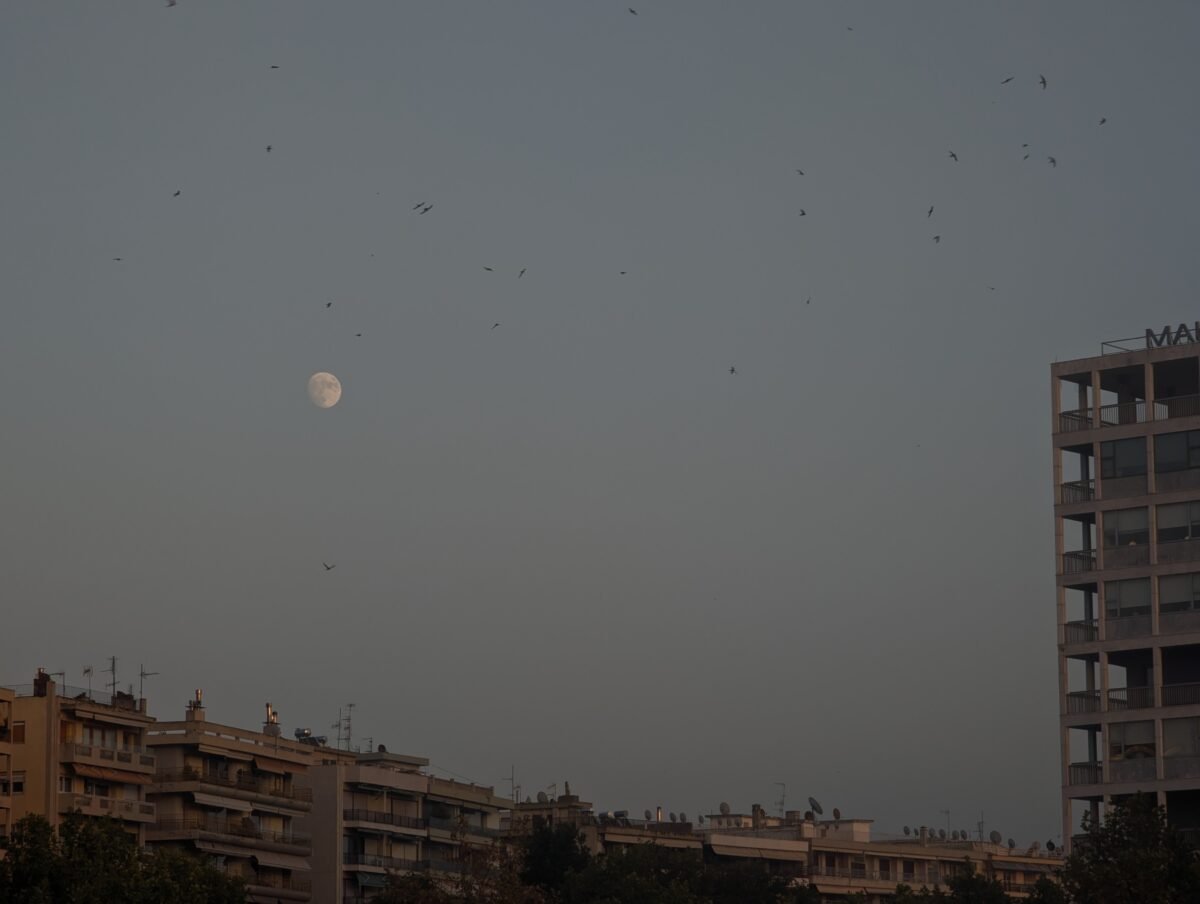
I met a friend of mine last week, Jason, whom I met in Latvia last March. Both loving a bit of a long, philosophizing conversation, we went for a short walk up to Ano Poli, passing by Kemal Ataturk’s House, and ending up at a favorite cafe of mine, up to its windy terrace.
I’ve always faced the city as it is in constant lethargy; unable to change one bit, in lethe (i.e. (the Greek concept of oblivion or forgetfulness). Yet what surprised me, this time, was that Greece sounded so different to my ears, this time. Conversations in all languages were audible from each tavern & cafe, passersby from all places marveling at its Byzantine walls & Roman ruins.
I explained to Jason how this brought me a bit of hope.
We somehow ended up bringing Thessaloniki to its worst state in centuries, in our modern day. A city that was left to its demise, without its international charm, without even a glimpse of hope for a better day.
After all, Thessaloniki was always this international city that, whatever hands it was in, never failed to shine through. A place where Greeks, Romans, Bulgarians & Serbs, Jews, and Turks lived and marveled together, so much so managing to always bring a serious contest of power to the main centers of its subsequent empire. For the last century, Thessaloniki lost that character, yes; with the Jews (which arrived all the way back in 1492, as the Spanish Inquisition was expelling them from Iberia) being the sole lasting ethic group standing alongside Greeks, up until the Nazi horrors of WW2. Yet, it brought both me & Jason some hope, that, who knows; maybe Thessaloniki will bring that metropolitan identity back, rising from its ashes once more.
Or maybe not. Maybe that is still to be. Realistically, Greece, without treating its wounds, stands no chance of recovering in a geopolitical era where the force of the strongest gains ever more footing. Facing such a plethora of issues, from a demographic collapse to an enduring economic catastrophe, Greek society has to, at some time, escape its victim mentality & chronic polarization and see itself in the mirror.
We, Greeks, don’t trust ourselves. And, quite historically, we never did.
It seems like such a huge, complex problem to address, and it is: where to even begin?
I’ll finish the Greek in a future final chapter. For now, another country may follow. For all, I hope I’ll be able to give some coherent answers.
Thank you for reading; see you next month!
Comments are closed.