Sveiki! (Lithuanian for “hello”)! Are you ready to:
- Review an academic-grade article on sustainability?
- Wishing to get a better understanding of the technological sector and why it’s unsustainable?
- Trying to find ethical alternatives?
If so, you’re in for a treat. Good luck ahead!
Table of Contents
(Skippable) Personal Comment
The writing style of this is much different than the ones you can see on this webpage.
I also haven’t written about technology here since 2019, with an article about how searching the internet is about to change forever; that aged both like wine and milk, since I wasn’t aware of AI back then.
How did I come to write this? Well, long story, but I am back at university, admitted to an Erasmus Mundus programme called EMMIE. I am here to explore how I can utilize my vast, but somewhat unrelated at times, skill set towards making my own venture.
This journey brought me here, to Lithuania’s ISM School of Management & Economics, for a semester that focuses on Sustainability and Innovation. And so far, it has been a blast!
This was originally an assignment for one of our classes on Supply Chain Strategies, lectured by Dr. Christopher Kronenberg. It turned out so well-crafted that I thought it should see the light of day, with minor adaptations to make it more in line with my somewhat edgy style.
So, without further ado, I present you with the article. Enjoy
Glossary
Circular Supply Chain / Circular Economy: An economic model designed to eliminate waste by keeping products and materials in use as long as possible. Instead of the traditional “make it, use it, throw it away” approach, circular systems aim to repair, reuse, remanufacture, and recycle. The opposite of the linear “take-make-dispose” model (see below).
Linear Supply Chain (“Take-Make-Dispose”): The dominant industrial model we all know and love like Pavlov’s dogs of capitalism: extract raw materials, manufacture a product, sell it, and discard it at the end of life. Consumer electronics have historically followed this model almost exclusively.
Planned Obsolescence: The deliberate design of products to become outdated, unfashionable, or non-functional within a predictable timeframe, encouraging consumers to buy replacements. Can be physical (parts that wear out and can’t be replaced) or software-driven (updates that slow down older devices).
Modularity / Modular Design: A design philosophy where a product is built from interchangeable, independently replaceable components. A modular laptop, for example, lets you swap out the battery, screen, or RAM without replacing the whole device.
Reverse Logistics: The process of moving products or components backwards through the supply chain — from consumer back to manufacturer — for repair, refurbishment, recycling, or responsible disposal. A critical but expensive part of any circular system.
Design for Repair (DfR): An engineering approach that deliberately makes products easier to open, service, and fix. Prioritises longevity and repairability over thinness or aesthetic minimalism.
E-Waste (Electronic Waste): Discarded electronic devices and components. One of the fastest-growing and most toxic waste streams globally, containing hazardous materials including lead, mercury, and cadmium alongside recoverable precious metals.
Conflict Minerals: Raw materials mined in conflict zones, often under conditions involving human rights abuses, forced labour, or funding of armed groups. Tantalum, tin, tungsten, and gold (all used heavily in consumer electronics) are the most scrutinised, particularly from the Democratic Republic of Congo (DRC).
EU Right to Repair Directive: European Union legislation requiring manufacturers to make products repairable, provide access to spare parts at reasonable prices, and support products with software updates for defined minimum periods. Member States must implement it by July 2026.
Extended Producer Responsibility (EPR): A policy principle that holds manufacturers financially and operationally responsible for the end-of-life management of their products — including collection, recycling, and disposal. Shifts the cost of waste from taxpayers to producers.
Upstream / Downstream (Supply Chain): Upstream refers to the earlier stages of a supply chain: raw material extraction, component manufacturing, and supplier relationships. Downstream refers to later stages: distribution, retail, consumer use, and end-of-life.
Fair AI Usage Disclaimer: Glossary has been generated with AI (Claude Sonnet 4.6). They have been fact-checked and edited manually, as well as with Gemini Pro 3.1.
Introduction: Circular Sustainability and Technology
The trajectory of modern consumer electronics remains heavily in line with a traditional linear supply chain, inspired by classical capitalism: a model built on the flawed economic assumption that the extraction of virgin materials is both infinite and inherently more profitable than closed-loop recycling. For decades, this has been economically validated, and it remains demonstrably cheaper for manufacturers to use newly mined tantalum or gold from the DRC, similar to an “Uncle Sam”-attired King Leopold II, than to navigate the unexplored and underfunded logistical complexities and high capital costs of reverse logistics.
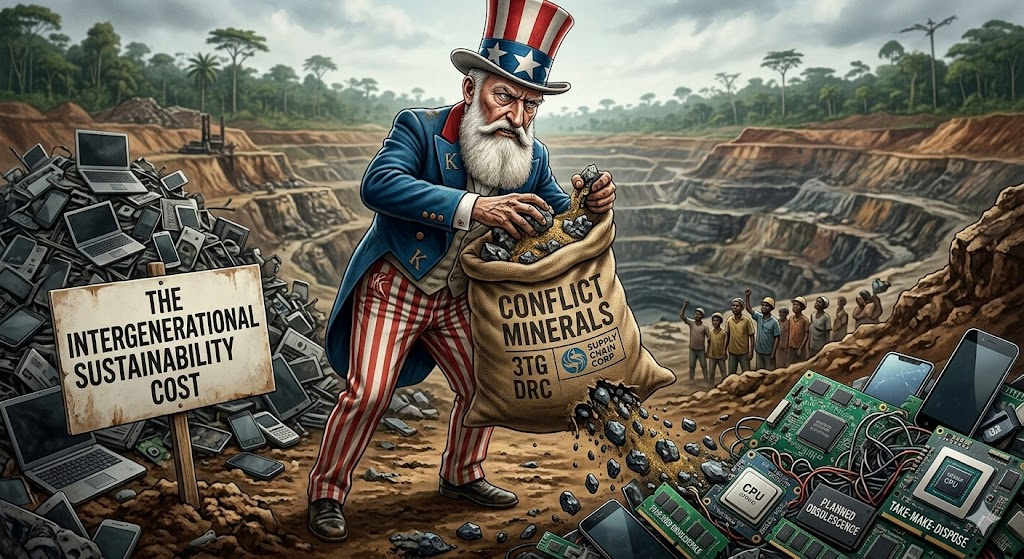
Fair AI Use: AI Generated Picture and in parts description.
In consumer behavior, this resembles a consumerism model that equilibrates and reinforces the loop-of-doom. Purchasing new is economically superior, psychologically attractive, and systematically encouraged. Whereas fixing an old device has become increasingly difficult over the years, upgrading it is progressively tougher, and, in some cases, even keeping it is strongly discouraged by software from OS & marketplace monopolies. Ergo, planned obsolescence.
This economic model masks a severe ethical deficit with a see-through satin. The procurement of these materials often relies on systemic human rights abuses and exploitative labor practices; the one referred to above being, regrettably, far from the sole example. While the current ‘take-make-dispose’ model may still dominate, its moral and environmental bankruptcy necessitates a transformation toward sustainable, circular supply chain management, aiming to minimize resource input and waste through closed-loop flows and product life extension (Geissdoerfer et al., 2017).
Thankfully, there are adopters. Two fairly different, yet frameworkingly similar companies exist, featuring circular sustainability supply chain business models deeply coded in their respective entrepreneurial BIOSes. The cases of Fairphone and Framework are worth reviewing as role models, and even if they never become mainstream, any popularity towards their causes is a benefit for the sector. A vote of confidence that sustainability matters in technology, and why it should be pursued.
Framework Reinforces What PCs Have Always Been: Modular
Desktops are much more sustainable than laptops have become, and for a while, they were the norm in computing. Originally, access to the internet resembled a rectangular box that produced dial-up sounds. That, however, changed over the years, as laptops became more accessible and price-competitive, offering portability without performance sacrifices for the average user.
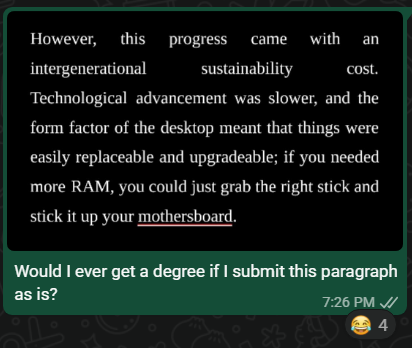
However, this progress came with an intergenerational sustainability cost. Before, technological advancement was slower, and the desktop’s form factor made components easily replaceable and upgradeable. This resulted in a twofold effect. Fewer frequent upgrades were needed, and such upgrades or repairs were modular, focusing on specific parts within the same form factor, replacing one component with another of the same type. It was a much more sustainable system.
When laptops became the norm and technological advancements in personal computing devices accelerated, this signaled the end of the “golden age” of modularity in personal electronics. This direction hasn’t necessarily been malintentioned. Competition of a plethora of well-positioned and respected brand names, such as US Dell & HP, Taiwanese Acer & Asus, and Chinese Lenovo, among other smaller or emerging players, was based on product characteristics, adding performance while subtracting space and weight, in razor-thin margins, supported by a general capitalistic consensus in the consumers’ zeitgeist. In such an environment, modularity was deprioritized and, at times, became impossible. Apple, the design and innovation leader in consumer electronics, further exacerbated the issue, pursuing thinner, more compact, and much less modular or internally-accessible devices.
This led to numerous realities in the sector; fixes became more difficult and required technicians, such as in the cases of batteries, screens, or hard drives. Also, in limited form factors usually under 14 inches, specific parts had to be soldered to the motherboard, such as the CPU, GPU, and RAM. Under such conditions, buying new devices almost always constituted a saner financial decision for both parties. At least, that was for the time being, as such conditions could be proven unsustainable in the near future.
Some saw the writing on the wall and wished to do something about it. A previous employee of Lenovo & Apple, Nirav Patel, founded Framework back in 2020, to create devices that are as upgradeable, repairable, and customized as possible. Their first device, Framework 13, packed considerable performance in under 1.5kg and was a product statement in its own; that the sector can now produce machines in tight form factors that are fully modular, respecting circular supply chain models that were before rejected as not profitable, or not competitive (Framework, 2023). And given the inherent modularity of the sector, this was proved to be realistic; components exist even outside of Framework’s ecosystem, with users being able to quickly and easily replace parts themselves if needed.
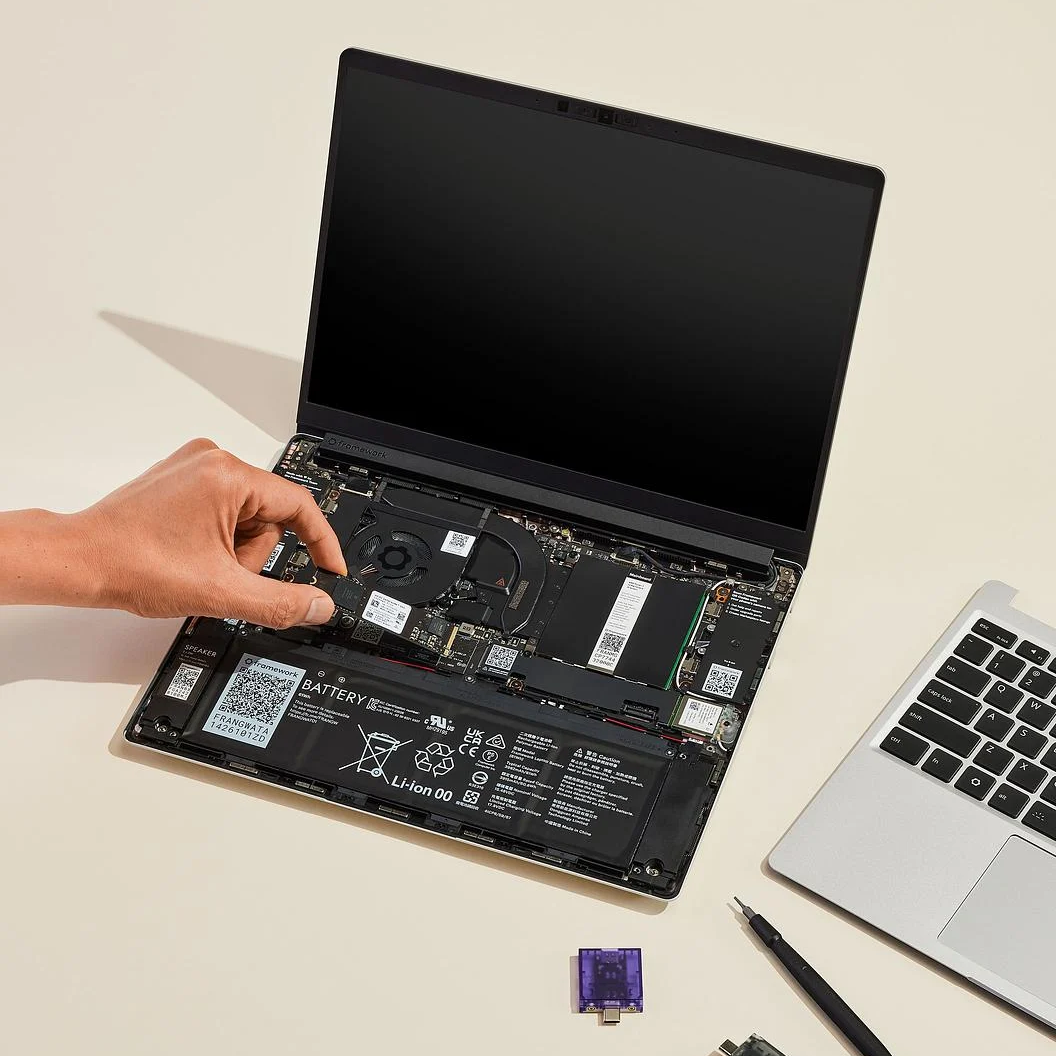
As the company evolved its offerings to four lines (three laptop sizes and one desktop), the sector also changed. The AI revolution drove the demand for computer components to never-before-seen levels. Current prices in computing components, particularly in RAM and GPUs, skyrocketed: for the former, showing 3x to 5x increases over the last 18 months in the US (pcpartpicker.com, 2026a), while the latter remain at exceptionally high levels (pcpartpicker.com, 2026b). This naturally led to a steep price increase in all personal electronics.
While terrible news to consumers in developed economies, already struggling with cost-of-living and inflation pressures, but also with at times dwindling job opportunities and technological threats, this can prove to be a change towards sustainability practices if promoted correctly. Sustainability should be ethical; yet it can be more than that to drive change in consumer behavior. Under such circumstances, companies like Framework gain a competitive advantage. The entry level is high for a new Framework computer; however, this is increasingly in line with the whole sector. What changes is the obsolescence of their devices, which, in these market conditions, can be seen as more significant and future-proof. Given how innovation stalled and the laptop form is considered highly mature (i.e., limited changes have been introduced to what we consider a laptop), companies like Framework are uniquely positioned: financially sound, innovative, and ethical, presenting a strong business case for sustainability.
Fairphone Begs the Question: Why Can’t We Be the Same?
In comparison, smartphones have never been modular, except for the removable batteries featured up to the 2000s. Similar reasons applied; in small form factors, each mm of space matters, rendering modularity impossible. But there was another issue, not previously applicable; the whole ecosystem was never conceived or evolved to be modular. Smartphone components, unlike in PCs, are not standardized. Consumers always bought “ready” phones. Similarly with the laptops market, multiple competitors had to compete under the pretty much same form factor in specific characteristics, driving the price down to highly accessible, yet highly unsustainable and illogical-for-circularity price levels.
This is why even companies like Google failed to drive modularity in the sector, and they have tried with Project Ara. In sustainability terms, there is considerable immaturity that renders such initiatives difficult. In part, that lack of the right ecosystem of components proved to be detrimental (Dediu, 2016). A business case with modularity in smartphones is difficult, but not impossible; enter, Fairphone.
Fairphone has been around since the mid 2010s, as one of the few circular supply chain alternatives offering modular smartphones. The Amsterdam-born smartphone producer managed to last long enough to reach six iterations and build a product ecosystem around it, enough to support obsolescence superior to competitors. Their latest model, The Fairphone (Gen. 6), offers 5 years of warranty and advertises 8 years of software updates. In comparison, Apple offers a 1-year manufacturer warranty (upgradeable with additional costs), and around 5-8 years of software updates; albeit such a figure is unofficial and may change. Considering same-OS alternatives, since Fairphone runs stock Android, Google offers 7 years of software updates, only for Pixel 8 and newer models, with similar warranty terms as Apple.
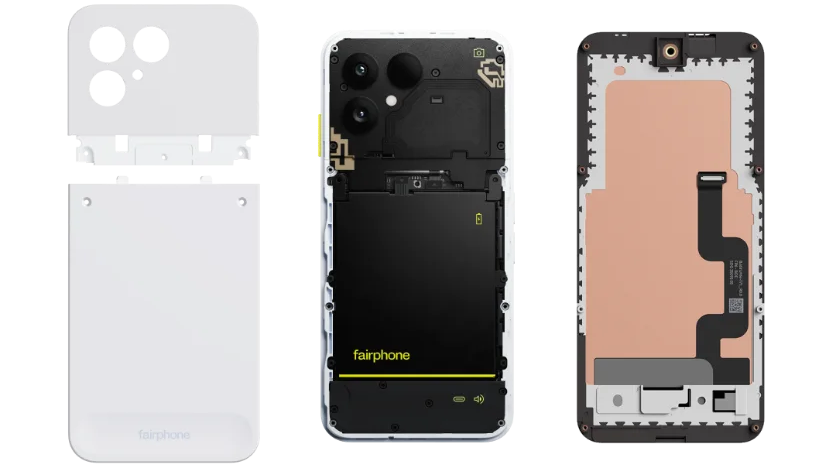
Currently, Fairphone users can swap some of the components; essential like screen, ports, or battery, and supplementary like the cameras or storage space. Modularity in smartphones is still limited; CPUs and RAM are not user-changeable. The Fairphone currently retails at 549 EUR, however, offering value that’s on par only with mid-tier flagships. Given these conditions, the company remains a niche phone producer, selling over 100,000 units in 2024; while profitable (Fairphone, 2025), the figures dwindle comparing mainstream, harshly unsustainable margins. Their appeal is highly concentrated on people who value sustainability, and they are willing to pay a price for it; a significant minority, which is not enough.
Conclusion: Make Technology Sustainable… For Once (MTSFO)
Consumer electronics are a textbook case in (un)sustainability. The industry has closely followed a “loop-of-doom” where infinite extraction meets planned obsolescence, generating catastrophic volumes of electronic waste. Global e-waste is projected to hit a staggering 82 million metric tonnes annually by 2030 (UNITAR, 2024). Yet, as the macroeconomic landscape shifts and AI-driven component shortages drive prices to unprecedented highs, the financial and environmental cracks in this linear supply chain are becoming impossible to ignore.
Framework and Fairphone stand as vital counter-narratives. Framework proved that by leveraging standardized components, a company can successfully resurrect the modularity of the desktop era in a modern, profitable laptop form factor. Fairphone took on the infinitely harder task of wrestling an unstandardized, closed mobile supply chain into submission. While they didn’t deliver a knockout, they’re still standing; successfully launching six generations of devices, they proved that upstream ethical procurement and downstream repairability are technically feasible, even if economically punishing under current market conditions. And thankfully, other brands experiment accordingly. Tecno presented a futuristic, unbelievably thin modular smartphone concept at MWC (Smith, 2026), and Lenovo presented a modular dual-screen laptop that received positive acclaim (Buzzi, 2026).
There are reasons to believe that the luxury of ignoring circular supply chain models in the sector is expiring. The European Union’s legislative power can become that final booster needed to switch, similar to how they pushed manufacturers into the common USB-C protocol (EU Commission, 2024a). With the European Union’s Right to Repair directive forcing Member States to transpose and apply strict repairability and spare-part accessibility rules by July 2026 (European Commission, 2024b), the legislative hammer is taking action against the “take-make-dispose” era. Tech giants will soon be legally forced to adopt the exact supply chain mechanics, such as accessible components, extended software lifecycles, and Design for Repair (DfR), that Framework and Fairphone have been pioneering for years. If the industry wishes to survive the tightening grip of legislation and resource scarcity, and offer value to consumers stricken by forces that shrink their purchasing power, it has no choice but to look at the entrepreneurial BIOSes of Framework and Fairphone and press, for the sake of us all: CTR+C, CTR+V.
References
- Buzzi, M. (2026, March). Lenovo’s Modular, Two-Screen ThinkBook Is the Futuristic Laptop I’m Rooting For. PCMAG; PCMag. https://www.pcmag.com/news/lenovo-thinkbook-modular-ai-pc-concept-futuristic-laptop-hands-on-mwc-2026
- Dediu, H. (2016, September 27). The demise of Google’s Project Ara and modularity in computing. Christensen Institute. https://www.christenseninstitute.org/blog/the-demise-of-googles-project-ara-and-modularity-in-computing/
- EU Commission. (2024, December 28). EU common charger rules: Power all your devices with a single charger. European Commission. https://commission.europa.eu/news-and-media/news/eu-common-charger-rules-power-all-your-devices-single-charger-2024-12-28_en
- European Commission. (2024). Directive on repair of goods. European Commission. https://commission.europa.eu/law/law-topic/consumer-protection-law/directive-repair-goods_e
- Fairphone. (2025, November). Europe’s Fairphone expands to the US amid strong growth and record 2025 Q3 performance. https://www.fairphone.com/wp-content/uploads/2025/11/Europes-Fairphone-Expands-to-the-US-Amid-Strong-Growth-and-Record-2025-Q3-Performance-1.pdf
- Framework. (2023). Framework | Sustainability. Perfect-Hiring-822947.Framer.app. https://frame.work/sustainability
- Geissdoerfer, M., Savaget, P., Bocken, N. M. P., & Hultink, E. J. (2017). The Circular Economy – a New Sustainability paradigm? Journal of Cleaner Production, 143(1), 757–768. https://doi.org/10.1016/j.jclepro.2016.12.048
- pcpartpicker.com. (2026a). GPU Price Trends in the US. Pcpartpicker.com; PCPartPicker. https://pcpartpicker.com/trends/price/video-card/#gpu.chipset.geforce-rtx-5080
- pcpartpicker.com. (2026b). RAM Price Progression in the US. Pcpartpicker.com. https://pcpartpicker.com/trends/price/memory/
- Smith, M. (2026, March 2). At MWC, Tecno’s super-thin modular concept phone doesn’t even have a wired charging port. Engadget. https://www.engadget.com/mobile/smartphones/at-mwc-tecnos-super-thin-modular-concept-phone-doesnt-even-have-a-wired-charging-port-123129135.html
- UNITAR. (2024). The global E-waste Monitor 2024 – Electronic Waste Rising Five Times Faster than Documented E-waste Recycling: UN. E-Waste Monitor. https://ewastemonitor.info/the-global-e-waste-monitor-2024/
Comments are closed.