Bonjour! This essay is an exploration of:
- The atrophy of Western values
- The philosophical roots of that collapse
- How my experience in Brussels makes me see there’s an alternative
The views expressed in this article are entirely my own and do not represent the positions of the EU-US Young Leaders Seminar, its organizers, or any affiliated institutions.
Table of Contents
Setting the Stage
“Today, I’ll talk about the rupture in the world order, the end of a nice story, and the beginning of a brutal reality where geopolitics among the great powers is not subject to any constraints.”
From the podium at Davos, back on January 20th, Mark Carney, the Canadian Prime Minister, echoed across the room as an ominous message. It came at a point of great geopolitical uncertainty. January 2026 was, after all, marked by the unprecedented: the US threatening a European ally, Denmark, with military force over Greenland.
He followed with his call to action: the conclusion to his argument.
“But I also submit to you that other countries, particularly middle powers like Canada, are not powerless. They have the capacity to build a new order that embodies our values, like respect for human rights, sustainable development, solidarity, sovereignty, and territorial integrity of states.”
The world is, indeed, changing.
To that, new dividing chapters were added over the past two months following Mark Carney’s speech. The post-Soviet, US-hegemonied world order of the past thirty years has drifted apart. It is not only Greenland, but the tariff threats and trade wars, the war of Israel against Palestine, and the Epstein files, featuring figures transatlantically. Most recently, the war in Iran: a conflict that caught all US allies by surprise. European forces were not consulted, rather forcefully asked to join after the war began. The current EU stance, as well as the alliance denudation of the US, at least highlights that there is a tension between those two allies.
How deep is such tension? Only future generations will comprehend, historically reflecting on whether such injury would be healable or terminal and ruptured beyond repair. At the moment, we, the present generation, have come to bear the uncertainty of the times. EU-US relations resemble a couple clouded with doubts over the other, one step in, one step out in their union; once doubts arise and the spell of love is dissolved, what logic or emotion may hold them together?
A Historical Review of Western Values & the Transatlantic Alliance
It is worth revisiting the history of how such an alliance came to be, even if it seems so obvious to us all.
It was in the mid 40s where the post-WW2 devastation proved enough for the global North sides of the Atlantic to draw a common path. The fear of the growing other, Soviet Union-flavored communism-totalitarianism, intertwined these sides further. Be it out of necessity, post-traumatic guilt, or fear of what humanity is capable of, both sides of the Atlantic have shown how little they have in setting them apart. The values were clear, and clearly shared: democratic systems, human rights, and a growing economic system that promised prosperity.
For decades, battle-battered US Americans and Europeans could not forget the horrors. Fresh in their memory of the US booted soldiers, still present for those Europeans having to collect the pieces of their continent, they worked together. They collaborated, not to repeat the same mistakes. Even decades later, recovered from their wounds, a peek over the other side of the iron curtain could remind them what they were fighting for: In the words of John F. Kennedy in 1963, “Freedom has many difficulties and democracy is not perfect, but we have never had to put a wall up to keep our people in”. When their governments deviated from their self-proclaimed values, those same old citizens and their younger children, even with more fervor in protecting this newly found system, fought—fought to keep everything in balance. They fought against racial inequality, inspired by Martin Luther King; existential philosophers of France fought against French imperialism, inspiring the masses. There was a common societal agreement still intact; we believed in democracy, we believed in freedom. Most importantly, we believed that we were better; better than them, the other side of that damned commie wall, and that kept us going in our efforts to build better societies.
But the Soviet Union, that necessary other for such an equation to be proven, did not hold on. Thankfully for our sisters and brothers-in-values from Poland, Lithuania, Latvia, Estonia, Romania, Bulgaria, Moldova, Ukraine, Czechia, Slovakia, East Germany, Georgia, and Armenia, countries that craved to receive what they weren’t allowed before: the experience and the values of the West, of democracy and human rights. There was no other, no more; only the US and its allies. The Cold War ended. Fukuyama’s “The End of History and the Last Man” proclaimed there was a societal victor, one that will remain unchallenged until the end of time. Capitalism, human rights, democracy: that’s how things will come to be, and there is only a matter of time until the rest of humanity catches that dogma.
It felt like the time to be alive, just for a second. Technology promised to solve us all. Capitalism’s charm, marketing, replaced human needs with crafted strategies, playing with a biological reality as old as time: that to survive is to do so through the path of least resistance. In global-north societies, such resistance was effectively dismantled, piece by piece, plate out to plate off away from our discomfort bar away from having much on our plate—and comfort became synonymous with living. Generations iterating what is right to be human above all else, led to humans focusing on themselves, in the absence of resistance that draws us back together. All of these are for the focus on the commons being atrophied. The environment kept being abused by our negligence. The switch to individualism appeared definite: we only cared for ourselves, in the absence of any immediate dangers enough to signal our primitive brains on.
What Brought Us to the Point of Collapse of Western Values
It is established that our economic systems are based on trust. Simply put, when this trust overflows and is unjustified, it leads to bubbles. Bubbles burst lead to crises.
We easily think of bubbles in economies; the logic is understandable. Yet, rarely do we perform the short, intuitive logical leap in seeing how entire societies can be in bubbles; ones that are unsustainable and, somehow, sometime, they will collapse.
There were numerous signs that this global order was not to last; from the post 9/11 President Bush meddlings in Iraq and Afghanistan that had no real plan for the aftermath, to the elite-protectionist policies of the Obama administration that drove no social justice after the 2008 financial crisis. The EU blindly followed in all, only sparingly voicing presse-papier declarations of values that no one truly cared for and driving no real action, memefying its role as an international, useless observer. Everyone in this unprecedented global historical alliance grew soft and complacent, forgetting what it took to reach this hegemony. The societies, the governments, ourselves. Each crisis is different; what remains is the moral bankruptcy of what defines us, loosening the terms little by little.
In the meantime, all the other sides were lurking, progressing, returning from their shadows. China never switched to Western values once trade opened; that was a false President Clinton-led hypothesis. Russia was left unopposed to consolidate and dream of its former imperialistic glories, and the EU did nothing but support it, all in the name of cheap gas and oil that would support its citizens, no matter the moral cost; we just thought that by supporting a dictatorial regime, this would keep them in check: have we learned nothing from Chamberlain’s appeasement strategies? They are not the only ones: Turkiye backslides to its Ottoman roots under President Erdogan’s imperialistic wishes. India is radicalizing and uniting under President Modi’s right populist narratives. Brazil narrowly escaped Bolsonaro’s grasp, due to the existence of a figure that could inspire Brazilians against him: a certain President Lula, currently 80 years old, with no clear successor of equal popularity. The other(s) were returning, in all of their different flavors, yet all focusing on values of the past to attract the masses to justify the absence of Western values; what did not return were these Western values that kept our Western values, and therefore us, connected.
It’s easy to throw blame to one obvious scapegoat; that is a fallacy. What we face is not due to one current US administration; it has been in the making for decades. With equal parts of tragedy, irony, and poetry, President Trump never truly changed careers in our lifetime; he remained a capable showman with a knack for transposing realities into their simplest form, for billions and billions of people to be intrigued and entertained. Without truly altering the scenario that has been written successively, from each successive US and EU administration, he was only there to reenact it, as fast-track-edly as possible. For such a geopolitical actor, there is no Nobel Peace Prize to be gained; yet there shall be plenty deserving Oscars and Emmys to be nominated in his name.
The newest episode is about Trump, as well. Go check it out!
Thus, we are brought to such a state: in a ruptured world that we can’t seem to agree on, with a world order that withers.
Why the Collapse of Western Values & the Alliance Was Philosophical Before It Was Political
Two thinkers shaped my perspective on why.
On the one side, Byung-Chul Han, the Korean-German philosopher, offers perhaps the most unsettling diagnosis of our present condition precisely because his target is not the usual suspects. It is not authoritarianism that concerns him, nor geopolitics. His ideas discuss something greater, the quiet dissolution of everything that binds human beings together from within. In his Burnout Society and Disappearance of Rituals, Han argues that late capitalism has replaced external repression with something far more effective: the internalized mandate to self-optimize, an enslavement of “be what you want, always improve” positive power, far more effective than the “you are not allowed to” negativity of the past. “Liberated” from the obligations of the commons, facing less collective immediate frictions, individuals gravitated towards their own sovereignty. In doing so, losing the rituals, the shared narratives, and the constructive friction with the other that historically gave societies their coherence. It is not shocking to claim that we live in an era of individuals. An era where, quoting Han, we communicate without communities. All those values of our Western, status-quoed order remain empty, but we are the ones to blame. We dismantled the conditions under which values can actually be held in common and mean something to us all.
And on the other, Alasdair MacIntyre: explaining why this dismantling was not accidental. In After Virtue, his landmark 1981 work, MacIntyre argued that modern moral discourse is in a state of profound disorder; that we lost the shared narrative context that once gave moral language its meaning. We cared for justice, for democracy, for rights, while increasingly losing our connection with the terms themselves. In ancient Greece, purpose was derived entirely by the commons; in the Roman Republic, by gravitas. For centuries, values were given to us by the word of God, until we killed him, as per Nietzsche’s notions. Nationalism followed, and we rallied our values around the flag, until Fascism and Nazism killed the flag’s pride. And while we progressed through the Cold War, we may have killed the other, but in the face of the other, we killed what was necessary to make us feel ourselves. MacIntyre’s insight applied here: the liberal order has been speaking the language of shared values for decades, while the story underneath that language was quietly collapsing.
It is this philosophical vacuum, before it is political, that the populist right has proven far more adept at filling. They offer what MacIntyre says humans cannot live without: a legible narrative, a defined community, a clear sense of what is worth defending – a vague, unrealizable presence of the past. The liberal status quo; the centrists, moderates, or the leftists, on the other hand? They inherited the vocabulary of the Enlightenment, expressed by the pluralism of our times, reaching for the some individuals somehow developed vaguely similar ideas across their own, “unique” life projects. The chance of the few does not stand a chance against the saudade of the many, in a system that idolizes nostalgia over the mourning of everything that made us, atoms, a whole.
The right is a far more effective political force because we can’t agree on new values that tackle the most important issue of our times; many of what we conceived before can be applied in our context. The ones that are established, to the people who feel most threatened or forgotten by the status quo: the older generations that cannot seem to adapt to the times; the younger men who struggle to find their place in this evolving, towards the so delayed gender equality context, never taught how to handle their emotions; even the marginalized, who are falsely promised a better future under fake premises and comforting narratives. Their needs are valid. It is we who never cared to address them properly, polarizing them against us, marking them as foreign.
The institutions we built medievally; our brains developed to hunt and gather. Our values? Those were built in fear of something greater than ourselves in environments we were not able to control, filling the gaps of our logic on why that is. Or, on a danger that we can feel now, one that we can rally against, because it contradicts our own existence to such a foundational level that we cannot do without it. In a world that’s ever changing, the right weaponizes the values of the old.
Byung-Chul Han, Korean-born himself, is an exceptional thinker also due to his origins: eastern-raised, western-specialized. His ideas harmoniously marry both schools of thought, unlike many Western thinkers who were primarily inspired by the Ancient Greek and Christian ideas, snobbing the other. In a yin-yang depiction, Han refers to constructive negativity: that friction that we effectively work to eliminate, sometimes through capitalism, and on a geopolitical level, that other that fell on the 26th of December, 1991. That friction keeps us engaged, not apart; it gives us a reason to unite, and not wither. Across all human history, it gave us an identity, and the other became so important to us, so necessary, as without it, we stand nowhere in ourselves.
We wither and atrophy. We implode under our own weight. And we crumble.
Mark Carney referred extensively to these values: human rights, solidarity, and democracy. Yet, even between us, within us, even, in the EU, in our member states, we cannot seem to agree.
Yes, the world is changing.
Yes, the existence of the others can give us this opportunity to bring this common ground back with us.
But we will once more be able to define what all these are by seeing what the others are not, and maybe find some common ground with us.
What about the Transatlantic Alliance? Thoughts from the EU-US Young Leaders Seminar 2026, in Brussels
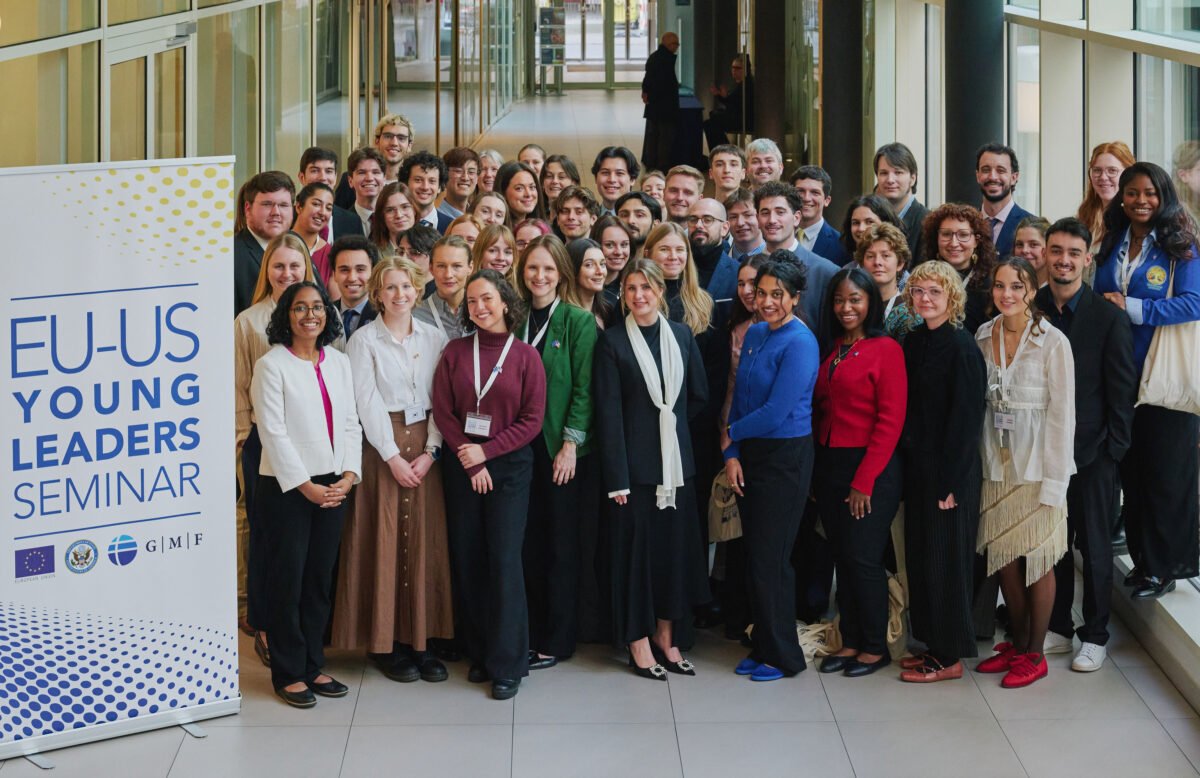
And kudos to Pryzm for the amazing pictures!
This article has been inspired by a recent event I have been very privileged and grateful to attend, as someone from humble origins: a low-income family with one breadwinner, a mom who took care of us and the house with immense individual sacrifice, a dad who worked almost 40 years, swift in, swift out, in the same factory, same role, behind the machines of similar functions. A business that changed hands three times, yet my dad remained there. An economy that drove itself to shambles and never recovered, limiting the potential and dreams of an entire nation.
But here I was: a 30-year-old from Greece in a EU-US young leaders seminar for scholarship holders, directly from the US and EU governments. I would not have fathomed, in my wildest dreams, 15 years earlier, as I was a teenager, under these conditions. Nor this, nor my whole journey covered as a person. I felt honored to represent my family and nation, being surrounded by 49 other outstanding minds from the US and various EU countries.
Once there, however, it was hard not to address the elephants in the room, between us; yes, our transatlantic relations are shaken to the core. That lingered, only for the first couple of minutes of our meetup. After that was voiced out and passed from us, we saw how much more we had in common; how much we valued discussing with ourselves, our ideas, our agreements.
When humans get inside the same room, something magical can still happen. With the best intentions, with dialogue instead of polarization or disengagement, we see how little the US and EU have to be divided. There are valid points to be made from both sides; the overreliance of the EU on US defence, while at the same time, the dissolution of the EU’s industries and technology development from the monopolic hegemony of the US tech sector. There are issues to be addressed, as with every relationship: what matters is the willingness to solve them and to agree between us, to find consensus, to explore ways to transform conflicts into win-wins for both sides.
But, before that, we have a lot of work to do. To start from the beginning. To redefine radically is a necessity; to smoothly and gradually integrate such changes is the next step.
What are our values, and what do they mean, exactly?
It’s time to get back to the drawing board. That should be our priority.
- To return to our local communities as leaders and communicate with them.
- To understand the victims of populism that threaten our democratic values, and to understand that, in most cases, behind even the most hateful narratives and closed-minded opinions, there are human needs that are craving to be addressed: threatened needs for connection, for safety, for self-definition and autonomy.
- To get the most we can into the same board; to redefine where our values stand, what needs we need to cover first, and find ways to realistically achieve them
Community by community, yet with as holistic, glocal orientation as possible. Each leader, from our own points of view, from our own expertise.
There is another scenario: to just… wait.
Wait, until the others bring us back to direct conflict, and take us to our human nature. Wait, until there’s past the event horizon of our trajectory. Wait until it is the only viable outcome.
Wait and hope that things will figure themselves out; that technology will save us; that we’ll have a future after another global conflict; that we’ll help us redefine who we are, and who we shouldn’t be.
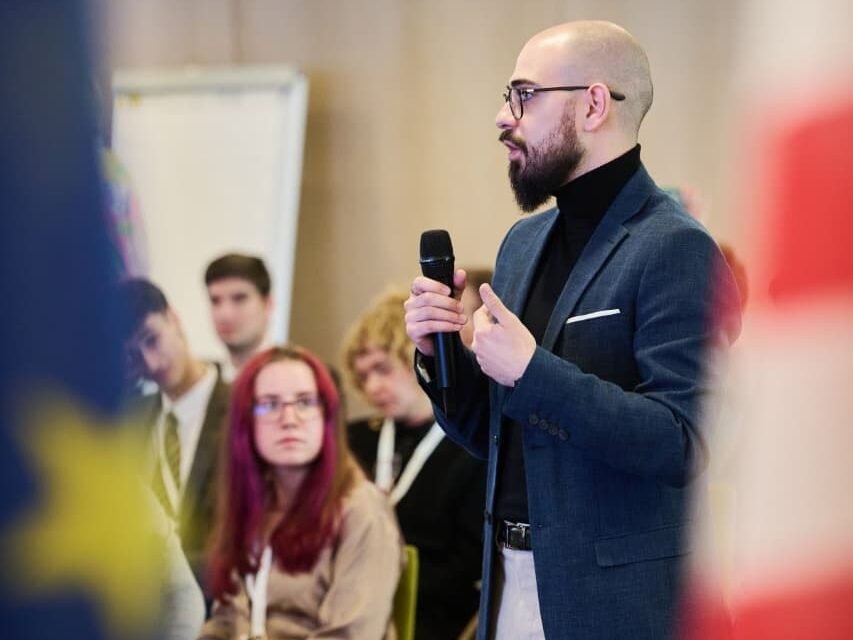
I remember a discussion I had from those days in Brussels: with a young leader from the US, a researcher, and me.
I asked them both about what kind of values we need for a common path together. My colleague came up with an opposing angle: the value system does not work altogether, so what would it be scrapped for?
The researcher, cynically, replied with a historical narrative. That a conflict, whether it is WW3 or CW2, is unavoidable. What works for us is that, after a conflict, we seem to find clarity in redefining ourselves, once more.
That was, and still is, our human condition. We can wait enough, and we’ll be granted our wish – to define who we are through someone else.
I still prefer the first scenario; I am committed to it.
But I refuse it as optimism. I refuse it because accepting the alternative means conceding that the values we claim to hold only become real when they are threatened, never when they are practiced. That concession is the bubble. And we have seen what happens when bubbles burst.
Each leader, I am sure, will approach it differently.
And I’ll do my best to find others along the way to make this a reality.
Because the other scenario looks far too dangerous to consider.
What am I trying to do, as one of those leaders?
I’m trying to gather the right tools, resources, and people to create Phronisis.
I wish to make Phronisis an organization that empowers individuals to think more clearly, question more deeply, and act more wisely through programmes and initiatives that develop real-world critical thinking skills.
Its first project is already out: a podcast called “The World in Arguments“!
The World in Arguments takes arguments shaping our world and breaks them down step by step.
In each episode, we analyze one real-world claim made by politicians, founders, scientists, artists, or public figures. We clarify what is being argued, map the logic behind it, and examine whether the reasoning actually holds.
Not to tell you what to think, but to give you better tools to analyze arguments yourself.
One argument, one episode at a time.
Comments are closed.