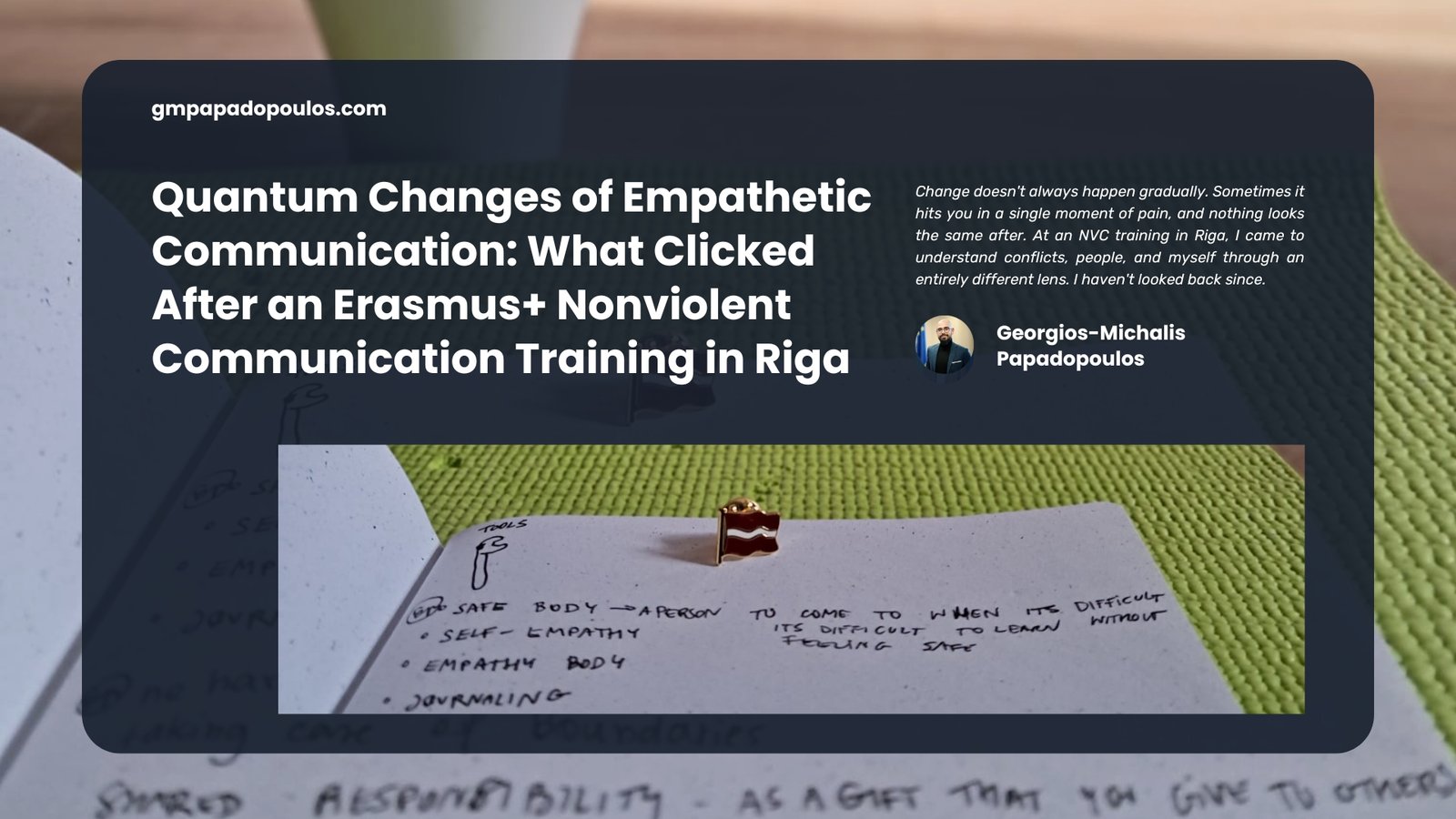
Labdien (Latvian for “good day”)! Stay, if:
- You want to learn what Nonviolent Communication is and how it works in practice.
- You’re curious about how a single experience can shift the way you see yourself and your conflicts.
- You enjoy philosophical undertones with your personal storytelling.
Fair warning: this one gets vulnerable. Proceed at your own risk!
Disclaimer: This article reflects my personal experience and interpretation of Nonviolent Communication. It is not a substitute for certified NVC training or psychological advice.
Table of Contents
Prologue: Quantum Changes
I happened to watch a video during the first days of March 2026, one that struck a chord within me. That video held a very simple premise: change can happen slowly, but sometimes that’s neither the most decisive nor appropriate way to do so.
That video was How To Change Your Entire Life In One Day from Mark Manson. He featured the science behind how people live these profound experiences that make everything click. They are named Quantum Changes.
There are two different kinds of events that can drive them. The ones that are insightful, profound realizations, and the mystical ones. The video makes an interesting case, but I’ve met it with plenty of resistance. It was a foreign idea to my gradual, nuanced process of changing.
I remember closing the video, wishing to get back to it soon, to contemplate the idea on a deeper level. I didn’t get my wish as fast as I wished. My March looked packed, something I haven’t experienced for years. Sure, a day or two, a week of constant busyness, never a whole month of contradicting experiences, needs, and responsibilities, with clients undergoing brand revamps, travels to four countries for various events, university classes and assignments, and my evergreen, ever-thirsty aspirations for creativity and growth.
I broke my wardrobe into two; one awaits my return from Riga to be packed for my upcoming trip to Brussels, for an EU-US young leaders summit. A polished, sharp one, addressing a radically different experience than the one I just left behind.
In Riga, the clothes I have been wearing for all those days were my casual ones, the vulnerable ones. The pieces that feel comfortable on my skin and laid back enough to reflect what’s underneath it. I wasn’t only in the right state of style, but in the right state of mind too; ready for what ended up to be a quantum change event itself.
One that I couldn’t necessarily foresee. I subscribed to something entirely different. I thought I would be joining a training course for Nonviolent Communication.
I’ll take a step back.
Empathy Journalists Nonviolent Communication Training in Riga, Organized by KALM trainings
I’ve been prioritizing an NVC training on my to-do list; and no, don’t feel alienated about this, I am far from being considered organized. Rather, it stayed in my head, reflecting on how I have been unable to deflect, to put out the fires of simmering polarizations or indifferences in conflicts I faced. I needed dialogue; I was asking for it, and I often failed to receive it.
I knew the method from various previous trainings; my previous piece on Conflict Transformation is connected to what I am about to share, for example, and I prompt you to go through both of them in sequence. They are highly complementary.
So, when I found out about a training in neighboring Latvia, organized by Marija’s Kalm Trainings, I was tempted. When I saw that there was also an NVC institute-certified instructor, Marta, I knew I had to try.
I reached out to Marija and… got rejected. I made a second question, and got rejected once more. Usually, I would stop there, not wishing to be annoying. That time, I took some advice from my own article on Conflict Transformation, and I asked a third, and actually final time, offering something else rather than my participation alone.
“Hey, how about if I both participate and volunteer?”
“Hm, I see you’re passionate about this. I’ll come back to you!”
And after a couple of days, I received another email; that I did not get selected. Thanks, I thought, but I knew I did all I could, so I dropped it from my mind.
Yet, it was a false negative; Marija reached out to me to confirm there’ll be a spot for me some days after that email, and I started making arrangements for my Latvian training.
I came in with judgments; I’ll learn ways to handle conflict with others, personally and professionally. And, for what I am trying to build as part of my EMMIE Erasmus Mundus project, to hold public dialogues that leave people satisfied with their need for connection, growth, and intellectual pursuit and stimulation. These were my initial motivations.
And I had more, one hidden, to bring my logic closer to my emotions.
With that mindset, I packed my openness and headed to Latvia. Yet I was about to receive something more.
What is Nonviolent Communication?
Marshall Rosenberg created the framework back in the 1960s.
He was a psychologist and a student of Carl Rogers, a man who spent his career in the thick of conflict: racial tensions, prison systems, warring communities.
He found himself asking the same question over and over: why do some people find it natural to contribute to the well-being of others, even under pressure, and why do others disconnect entirely?
His answer was based on violence.
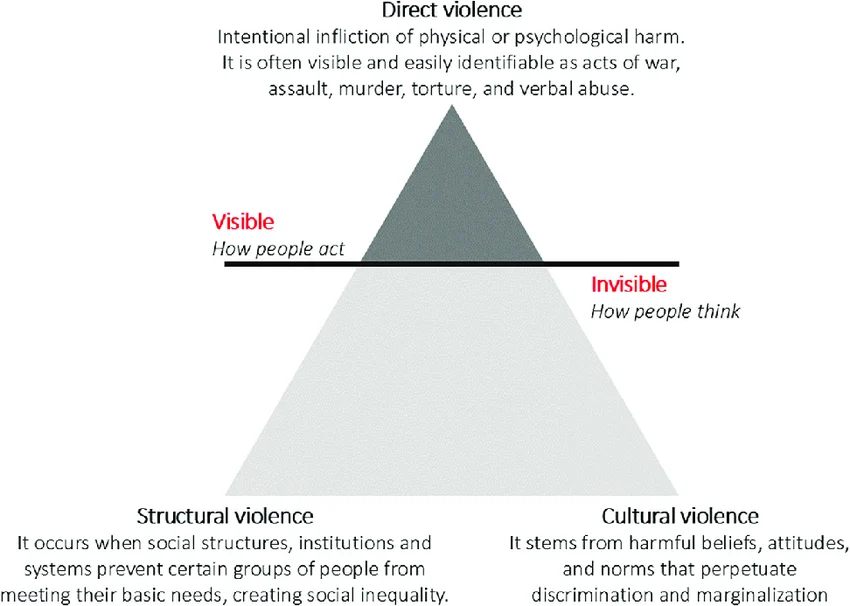
Violence doesn’t have to be only what is easily considered as such, directly physical or mental. The etymology of violence can be deceiving: Cambridge defines it as actions that are intended or likely to hurt people or cause damage. Through that definition, many instances of violence are simply hidden and remain untalked about. 1
Consider:
What would be diagnosing, judging, comparing, and demanding?
What would a language designed to coerce rather than to connect be, other than violent, other than a cause of friction and tension?
Underneath it all, beneath every conflict, every act of violence and silence, every argument that spirals past its original point, there are simply needs. Unmet, unexpressed, unheard.
One of the participants, fellow Greek Jason, spoiled the fact in our early discussions: that NVC is built on four components, and everything revolves around them. Throughout that week, I came to see why he was right.
One by one, there are:
Observations
What actually happened, stripped of interpretation.
Not “you were rude,” but “you raised your voice.”
The former is a verdict. While the latter is a frame of reference, both people can stand inside.
Feelings
What did that observation stir in you?
Not “I feel like you don’t care”. That’s a thought dressed in emotional clothing.
In nonviolent communication, feelings like “I feel cheated”, “I feel manipulated,” are called faux feelings.
Aren’t they also… a bit violent, these faux feelings? Not in causing damage, but in shifting the responsibility from ourselves to others.
“I felt scared,” or “I felt alienated, disconnected” are real, negatively associated feelings. Feelings that live in the body, not the mind’s courtroom, and are entirely ours to feel and own. No one else’s.
Good feelings, on the contrary, are positive signs. You feel happy, or energized, or excited when you meet needs.
Sidenote: Recognizing False From True Feelings
How to recognize faux from real feelings?
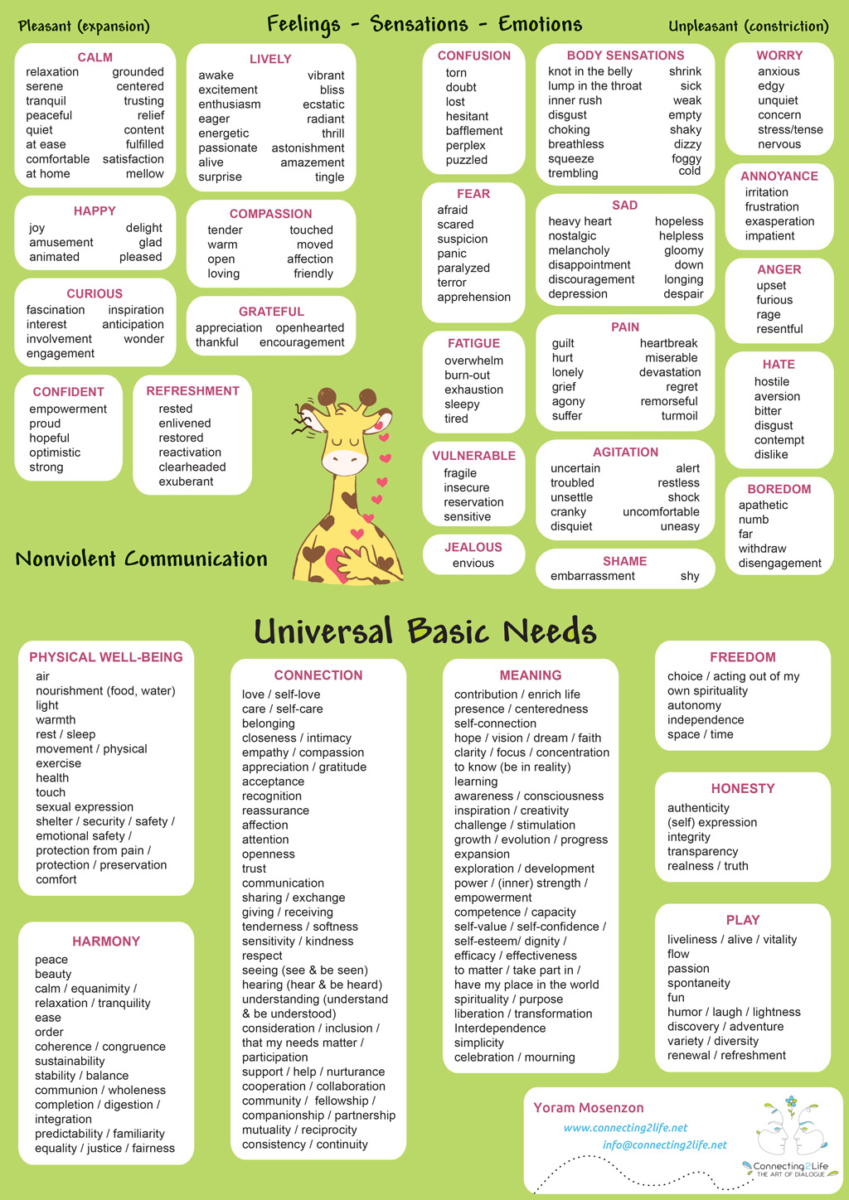
One option is to familiarize yourself with them. There are online lists, like the one below. Expanding your feeling vocabulary, past the usual “I am happy”, “I am sad”, “I am angry”, unlocks levels of self-awareness vital to your journey of self-understanding.
However, what if you want a rule of thumb? I had this question myself, I asked it to Marta. And her reaction?
“Real feelings are the ones you can mime/charade easily.”
I swear, I felt very frustrated by this answer. Like, what am I supposed to do with it?
So much so that I worked internally to disprove it for an hour or so. And, guess what? I lost! Marta was having a point.
False feelings are difficult to mime, given that they need context; someone did something to you to feel this way. True feelings come from within and can be embodied directly. You know what it means to be angry, happy, sad, and surprised. It’s entirely on you to embody.
Needs
The universal human drivers underneath those feelings.
Safety. Belonging. Autonomy. Recognition.
The brilliant, slightly disarming insight of NVC is that every feeling points to a need: either one being met, or one that isn’t.
And those needs? They are not personal quirks or weaknesses. They are shared. Every person in every room has them. Because one of the basic NVC assumptions is that we, humans, all share the same needs.
Requests
Specific, doable, present-tense asks are what is considered the last step of NVC.
“I need you to be more supportive” is too vague, too heavy, too easy to fail. Too guilty: I’ve fallen into that trap so many times.
But “Would you be willing to listen without offering solutions for the next ten minutes?” Something the other person can actually say yes or no to.
Focus on that last part. In NVC, a request is not a demand. Receiving a yes on your request is not the point. You leave space for the other person’s no, and in doing so, you make their yes mean something.
What Rosenberg built, at its core, is a practice of radical honesty paired with radical empathy. Both at once, which is harder than it sounds.
I came to learn that it is not a conflict resolution technique, not exactly, and much more than that. It is more of a relational posture. A way of listening that assumes, before the other person has spoken, that what they are about to say makes complete sense from where they are standing, and that your job is to find out where that is.
Because it does! It does make sense. That’s how they feel. They feel what they feel because they need something. A lot of the time, they won’t even know what they need. Why? Because they think with strategies.
What about… strategies?
The last part to consider is strategies. Requests are the fourth step. There’s a shadow version of this step that most of us default to instead: strategies.
The request is interpersonal. You voice it towards the other.
Strategy is the method you plan to achieve your needs.
But that’s the thing; strategies are not our needs. They are what we use to fulfill them.
How many times have you got stuck in strategies instead of focusing on the root of the issues? Your needs!
Guilty! I feel guilty for that point as well.
I came to change my relations with the others. Through the process, I started experiencing something different. I started changing my relationship with myself.
How Did We Practice Nonviolent Communication?
Obviously, I won’t share all the details. Confidentiality in such real, pure experiences is key for our common needs for trust, connection, and shared reality.
The beauty of non-formal education, the basis of all Erasmus+ Training Courses, lies in how experiential it is. It shares lots of common ground with the Socratic method: a facilitator knows where they need to go, but trusts that their participants will somehow know the answer and fill in the gaps.
This has been my 13th Erasmus project – thankfully, for any superstitious fellows out there, it failed to be the worst one. The method rarely fails. We came to learn the experience through our own reflections, anecdotes, and personal stories, in that room, step by step. From the introduction of what our subject is, to more complex somatic exercises.
Activity by activity, we started to build familiarity with NVC.
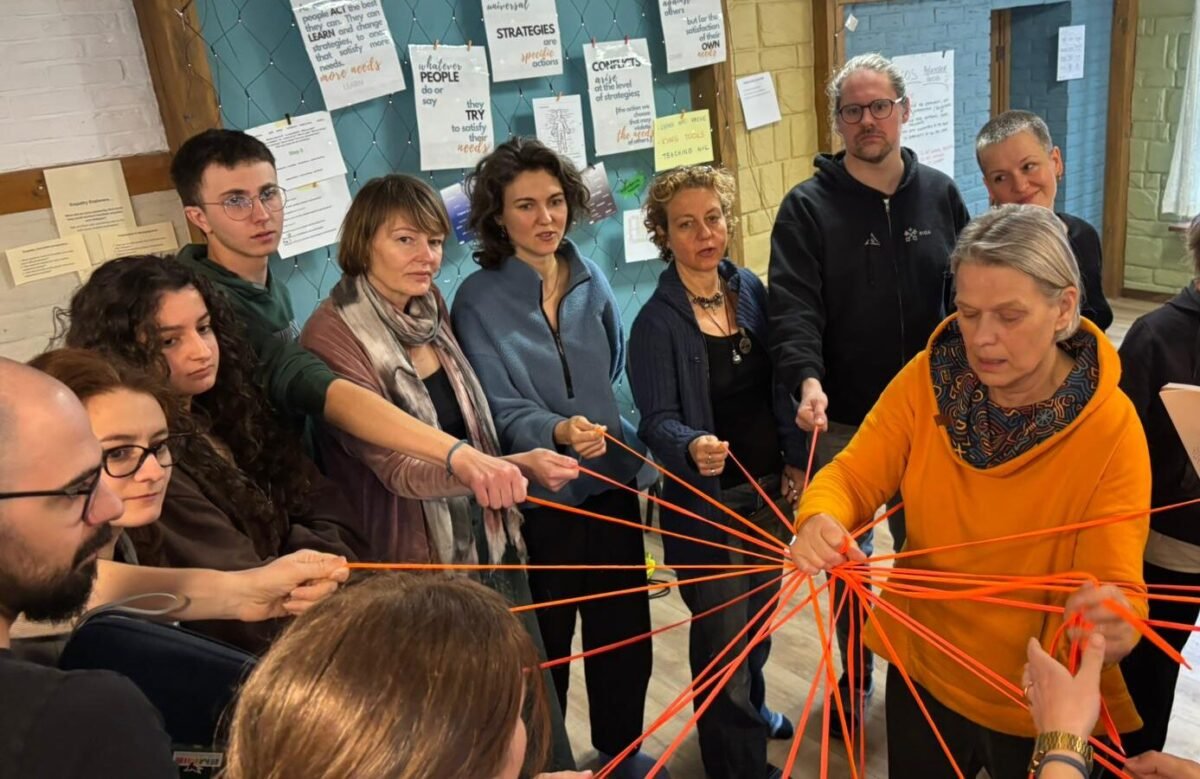
- We got empathy buddies to practice. For 15-30’, we were there to listen; the others would try to reflect back on us, to summarize what they heard as our feelings and needs in the situations. Then the other had the chance to speak about theirs.
- We used embodiment techniques. There are four steps in NVC: Observation -> Feeling -> Need -> Strategy/Request. We did some activities where we had to do these steps while going through that process. It sounds ridiculous if you don’t believe in embodiment, which I suggest you start doing by reading this article of mine about it. It helps because it puts the thought process into numerous perspectives.
- We held empathy circles, and these were powerful. We chose a topic of discussion, and each person had x minutes to discuss it. When they finished, the circle didn’t debate it: it reflected what feelings and needs it heard from them.
I’ll leave KALM’s International Training Facebook post to give the full list.
There were plenty of experiences, beshak2, but everything revolved around the same four steps: Observations. Feelings. Needs. Strategies or Requests.
The beauty of Nonviolent Communication: it’s radical simplicity, which somehow works so broadly in us humans.
And it worked with me, too.
The quantum change of NVC through my PoV
Throughout this event, I came to see my own pitfalls in communicating, as well as how I am pursuing my needs.
I had such an innocent-looking exchange with Marija, the first day of the programme. It went like this:
- Hey! Tomorrow’s the first official day, and there’s no one to ask for help with the kitchen tasks. Is it possible to help the cook and me tomorrow at 7:30 am?
- Oh, Marija, you’re killing me!
Now, if you carefully read up to this point, you would hopefully get what the issue is.
I was, of course, looking to sleep a bit more, to protect my energy for the upcoming days. I didn’t communicate that. I switched the blame instead to her, without even thinking.
In my family, with my friends back in Greece, in the Greek language, heck, in English even, in many cases? That’s a normal answer. But it is violent.
I never learned how to communicate limits properly. It was either passive aggressiveness, flat-out disengagement, false hope that things would fix themselves, and, in the end, extreme frustration and fights with the people around me.
At some time during the event, after physical and (mostly) mental exhaustion, I got sick. Light fever and fatigue that made me feel I had been hit by a train, kind of thing. I kept on pushing to show up; Marija came to me from the first moment and told me I shouldn’t – that I should focus on recovery. Still, I did try to be present.
Until, on the penultimate day of the programme, I started getting a migraine. I thought I would just survive it, so I ignored it until the pain went so severe that I had to seek some rest.
I headed to the shower; I left the hot water to pour on me, while nausea and that unbearable, disabling pain flooded my thoughts. A pain that lasted for two hours, but felt like an eternity.
And there it hit me, that I brought this to myself. Because I knew of my needs, but I placed them on the passenger seat, without any control over when they would be addressed.
For years, I faced issues with migraines. It’s a complex relationship I carry with me, recently in secret; I took an oath to stop speaking about them after my expat’s journey in Poland: two very important articles to me, that I wrote here quite some time ago.
To me, that day, they made sense. That migraines have always been an alarm – my personal alarm of my unmet needs.
This seems to be the situation for me. Surprisingly, there’s even scientific research that suggests this hypothesis: that migraines are simply a person’s last-ditch attempt to bring homeostasis to their body.
It’s been two weeks since that migraine. But from that day on, I never saw the world through the same lens as before.
I changed, quantumly. In that moment, one of pure agony and pain, that became my signal, both insightful in its knowledge, and mystical in its suffering. And NVC became my prescription.
(A Philosophical) Epilogue: Can Nonviolent Communication Truly Work?
As a marketer, I was taught from day one to satisfy needs, yet with all the wrong strategies. To me, NVC feels like a thought framework that helps me return to my roots in a way that now feels proper.
I am always very sceptical of thinking through only one lens. I agree with Camus here; to be dogmatic is a suicide, one of philosophy. So it feels important to provide any counterarguments I could think of for the method.
Assumptions of NVC
Dialectically, one can do so by considering the assumptions of NVC; kudos for the Bay Area Nonviolent Communication Blog post on it. These are:
- All human beings share the same needs
- All actions are attempts to meet needs
- Feelings point to needs being met or unmet
- The most direct path to peace is through self-connection
- Choice is internal
- All human beings have the capacity for compassion
- Human beings enjoy giving
- Human beings meet needs through interdependent relationships
- Our world offers abundant resources for meeting needs
- Human beings change
There will be obvious and nuanced exceptions to each, which I am not willing to ponder in this article. My focus is to fundamentally accept or reject them, on a rule-of-thumb basis.
Analyzing them as an argument, a basis to consider these ten premises as strong exists: due to our biology as human beings with clear social hierarchies to meet 6-8, arguably as dynamic creatures with free will, except if you are a determinist, meets 5 and 10.
There is also rationale in points 1 to 3. This hypothesis seems to stand by separating all faux feelings and strategies and shifting them down to their bare components. I am aware that this is a weak argument on my behalf, but I have been testing this hypothesis for the last two weeks, and it fundamentally checks out.
Doubts cloud me on points 4 and 9. They seemed, at first glance, as… too utopic.
We live in a violent world, far too deep into the rabbit hole to change.
Unable to consider another viable way of running things.
Running our mental engines to burnout, ensuring that we include no time for contemplation, just do.
And what do we do for it? We hide our needs with faux strategies, we focus our energies on not changing the system, but making such a system work, through business ideas and startups, through myopic, narrow-centered truths of absolutism.
In such a state, how can points 4 and 9 even hold?
And, no wonder, that can be, without even knowing it fully, the point that could make people critique NVC the most.
One of the most asked questions about NVC, at least during that week, was the following:
What happens when only one person speaks with NVC?
NVC has three main principles.
- To have this open-hearted stance of empathy.
- To choose to be responsible with our own actions & in peace with unmet needs
- To ensure all parties’ needs have space to be expressed.
NVC is a choice we make. For ourselves. It is not a transaction.
The harshest truth is that not everyone will care for your requests, even if you voice them in the most perfect way there is. You won’t receive empathy, you won’t receive space.
NVC may maximize your chances of getting these by fostering communication. It was developed in the 1960s, when the world was different. I wrote a piece about my Brussels experience, reflecting philosophically and geopolitically on how our values have atrophied, and our connections between us withered.
Yet, in an increasingly individualistic existence, where such adhesive values are weakened to the level of post-it adhesives, not social-cohesive superglue, what happens when we speak empathically?
I would argue that there will be plenty of instances where NVC won’t land, and that our needs will remain unaddressed.
However, what is the alternative? More violence? More recycling of a system that drives us to our demise?
People change; Yes. I agree with number 10 completely. And that experience changed me.
Changing is not a weakness. It is a sign of strength, of wisdom.3
To me, NVC seems to be the answer to so many problems, of myself & of our societies.
It is far from perfect in guaranteeing results. It is far from perfect dialectically, as I have many considerations to ponder upon, if my health allows me to live in old age.
I am probably going to be wrong with most of my bets. It’s unfortunate, but I am far too dumb, in my narrowness, in my idealism, in my origins, to ensure that what I think of is “the truth”.
Still: my beliefs, I try to defend with that same fervor and might, until I or someone else helps me to disprove them. Until they no longer serve me.
NVC is that new belief. Maybe someday, I will come across something of a quantum change that antithesizes it, and I will leave it behind me.
Yet, that day is not present. In the present, I’ll defend it until I can no more.
Sources and Disclaimer
- Marshall Rosenberg, Nonviolent Communication: A Language of Life: the foundational NVC text
- Centre for Nonviolent Communication: the responsible NVC training and certification body, founded by Marshall Rosenberg.
Footnotes
- On etymology, taxonomy, and its limits, Lucia (one of the participants in our nonviolent communication training in Riga) wrote an amazing poem, published in the collection Points of Intersection, page 36, by the Scottish Poetry Library. Give it a read!
- Beshak means Clear/Alright in Urdu (related words exist in Hindi, Arabic, or Farsi). Kudos to my friend Umair for managing to make this word stick with me.
- A lot of these points were made in consideration of Peter Singer, an amazing philosopher on ethics and morality, alive to this day. You can learn more about his life from one of my favorite podcasts, Philosophize This! Episode on him.
(Shameless) Self-Promoting Last Remarks
I mentioned my EMMIE project in the context: It will be called Phronisis
I wish to make Phronisis an organization that empowers individuals to think more clearly, question more deeply, and act more wisely through programmes and initiatives that develop real-world critical thinking skills.
Its first project is already out: a podcast called “The World in Arguments“!

The World in Arguments takes arguments shaping our world and breaks them down step by step.
In each episode, we analyze one real-world claim made by politicians, founders, scientists, artists, or public figures. We clarify what is being argued, map the logic behind it, and examine whether the reasoning actually holds.
Not to tell you what to think, but to give you better tools to analyze arguments yourself.
One argument, one episode at a time.
But I also want to say, NVC made me consider how we could create such opportunities for ourselves, to get back into dialogue with ourselves.
It might be the next project. Let’s see!
Comments are closed.